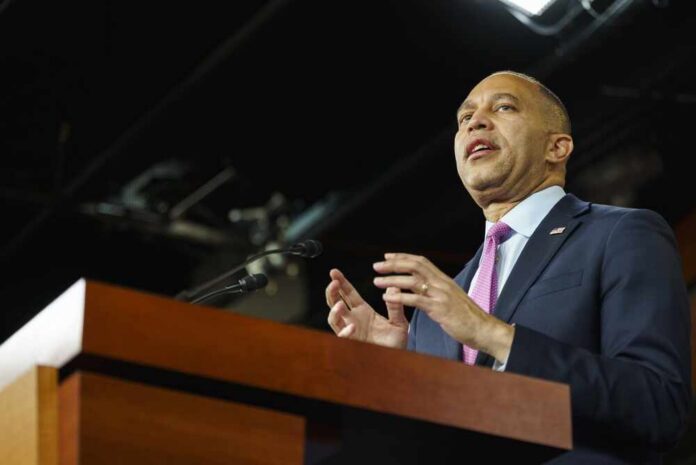
House Democratic Leader Hakeem Jeffries is threatening to stall critical national security surveillance unless President Trump removes Acting Director of National Intelligence Bill Pulte — turning a constitutional responsibility into a partisan ultimatum [7].
Story Snapshot
- Hakeem Jeffries links Section 702 reauthorization to ousting Acting DNI Bill Pulte, escalating a long-running surveillance fight [7].
- Democrats demand broader privacy reforms, while Republicans emphasize Section 702’s operational value for counterterrorism and cyber defense [3][9].
- Civil-liberties groups and some Democrats push for stricter Fourth Amendment protections within any renewal [10][12][5].
- Past House action shows reauthorization can pass with bipartisan votes when leadership allows a floor path [1].
Jeffries’ Pulte Ultimatum Puts Security Law In The Crosshairs
Hakeem Jeffries told reporters there is “no scenario” where he supports renewing Section 702 of the Foreign Intelligence Surveillance Act while Bill Pulte serves as Acting Director of National Intelligence, effectively tying a core intelligence authority to a personnel fight with the Trump administration [7]. Section 702 lets the government target foreign actors overseas, with incidental collection causing domestic privacy debates. Jeffries’ move layers a leadership dispute onto an already divisive, time-sensitive reauthorization battle [10][9].
Democrats have long argued that surveillance authorities require stronger guardrails to protect Americans’ privacy, citing warrant standards and minimization rules, while the Brennan Center highlights broad sweep risks that trigger civil-liberties alarms [10]. A bipartisan coalition letter also urges Congress to harden Fourth Amendment protections during renewal, signaling that skepticism extends beyond one party’s leadership [12][5]. Jeffries’ demand over Pulte intensifies pressure on the timeline, potentially complicating negotiations that historically require careful, bipartisan calibration [9][1].
Why Section 702 Matters To Counterterrorism And Cyber Defense
Republican lawmakers and many intelligence professionals frame Section 702 as indispensable for detecting foreign plots, tracking spies, and stopping cyber intrusions before they hit Americans at home, warning that lapses create blind spots adversaries exploit [3][9]. Senator Chuck Grassley has underscored the program’s national security role, reflecting years of cross-branch briefings that describe 702 as a backbone for time-sensitive foreign intelligence [3]. The White House — under multiple administrations — has faced a skeptical Congress while insisting the authority is vital [9].
Congress has previously found bipartisan pathways to reauthorize Section 702 when leadership permitted structured debate and amendments that addressed legitimate privacy concerns without gutting operational core tools [1]. House records show reauthorization can clear the chamber with support from both parties when members see credible oversight and compliance reforms that protect civil liberties while preserving foreign intelligence collection against non-United States persons abroad [1]. The challenge in 2026 is less the concept than the terms — and the new personnel condition Jeffries imposes [7].
The Personnel-Plus-Policy Gambit Raises Constitutional And Practical Questions
Conditioning a national security statute on removal of an acting intelligence chief blurs lines between Congress’s legislative power and the executive’s appointments authority, risking legislative brinkmanship over continuity in the intelligence community. Privacy advocates still press for warrants and tighter query rules, but the Pulte precondition adds leverage unrelated to the text of Section 702 itself [10][12]. That tactic could distract from hammering out precise reforms on querying, audits, reporting, and penalties that actually govern how the tool is used [12][10].
Jeffries says there’s no scenario where he would support FISA Section 702 renewal with Pulte serving as Acting DNI. FISA 702 expires early Saturday morning
— Chad Pergram (@ChadPergram) June 8, 2026
Democratic senators, including senior committee leaders, have demanded “serious reforms” before any renewal, emphasizing court oversight and civil-rights protections, a position that can be negotiated without personnel ultimatums [2][11]. Republicans counter that every week of delay invites risk from foreign adversaries probing America’s defenses, and they urge passage that locks in compliance fixes while preserving collection speed and agility [3][9]. Voters deserve a clean debate on the statute’s rules — not a shutdown threat premised on who occupies a temporary post [7][1].
Sources:
[1] YouTube – Jeffries: No FISA Reauthorization with Pulte as DNI
[2] Web – Himes Statement on House Passage of FISA 702 Reauthorization
[3] Web – In Senate Floor Speech, Durbin Calls For Opposition To FISA …
[5] Web – Section 702 of the Foreign Intelligence Surveillance Act (FISA): 2026 …
[7] Web – A view from DC: Congress’ FISA Section 702 stalemate reveals a …
[9] Web – Reform FISA Section 702 to Stop Government Surveillance … – 5 Calls
[10] Web – White House faces deeply skeptical Congress as it advocates for …
[11] Web – Section 702 of the Foreign Intelligence Surveillance Act
[12] Web – Senator Murray Issues Statement on FISA Section 702 …