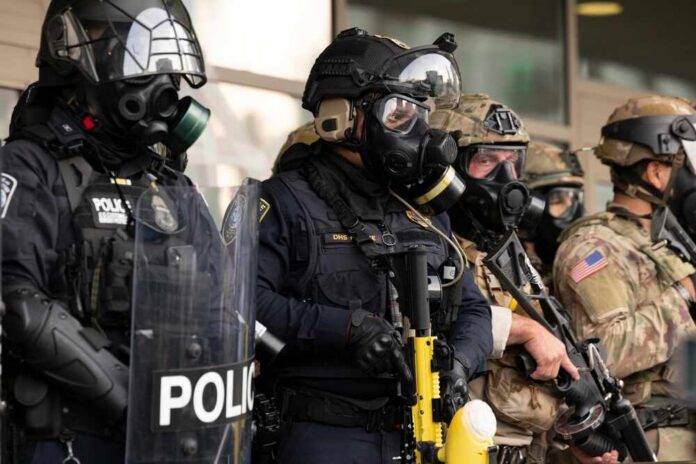
Blue-state lawmakers are using “anti-mask” bills to box in Trump’s immigration enforcement—forcing a fresh showdown over federal authority, officer safety, and who controls policing standards in America.
Story Snapshot
- Multiple Democratic-led states are advancing laws to restrict face coverings for law enforcement, including federal immigration agents, during public interactions.
- A federal judge blocked California’s first mask-ban law after finding it targeted federal officers by exempting state police—while allowing a separate ID requirement to stand.
- Washington state enacted a broader law in March 2026 that applies to all law enforcement, with exceptions for undercover work and certain safety-related scenarios.
- The Trump administration argues masks can be necessary to prevent doxxing, harassment, and attacks on federal agents during operations.
States Push “Unmasking” Laws After California’s Court Loss
Democratic-led legislatures are moving to limit when officers can cover their faces during public encounters, explicitly including federal immigration agents in many proposals. The push accelerated after a federal judge blocked California’s “No Secret Police Act,” reasoning that the state could not single out federal agents while exempting California law enforcement. Newer bills are drafted to apply evenly to federal, state, and local officers, aiming to survive the same constitutional objection.
Washington state is now a leading example. In March 2026, Gov. Bob Ferguson signed a law restricting facial coverings for law enforcement during public interactions, with exceptions that include undercover operations, tactical teams, religious purposes, and medical masks. The measure reportedly does not create specific criminal penalties, but it allows detained individuals to sue masked officers for damages—an enforcement mechanism that could shape behavior through litigation risk.
What the Federal Court Actually Said—And Why It Matters
The California dispute matters because it highlights the constitutional fault line: states have broad police powers, but they cannot discriminate against the federal government in ways that conflict with federal supremacy. In February 2026, U.S. District Judge Christina Snyder issued a preliminary injunction blocking California’s mask ban because it treated federal agents differently than state officers. At the same time, the court allowed California’s identification-focused “No Vigilantes Act” to proceed.
That split decision is a roadmap for other states. Judge Snyder’s reasoning indicated that a mask restriction might be more defensible if it applied equally to all law enforcement rather than singling out federal immigration officers. That is why states like Washington, and proposals in Oregon and Virginia, are framed as universal standards—an approach designed to avoid the specific discrimination problem that doomed California’s first attempt.
Accountability vs. Safety: The Core Tradeoff in Plain English
Supporters of the bills argue that masking and lack of visible identification reduces transparency during high-stakes encounters, especially in immigration enforcement. Human Rights Watch has warned that masked and unidentified federal agents can undermine trust and create conditions where abuses are harder to investigate. From that perspective, requiring clear identification and limiting masks is presented as a rule-of-law measure rather than a partisan weapon.
The Trump administration’s position, reflected in public statements, is that masking can be a practical safety step in a hostile environment. Attorney General Pamela Bondi praised the court decision blocking California’s law and has emphasized that federal agents are subject to harassment, doxxing, obstruction, and attacks. The available reporting does not quantify those threats, but it does establish that the administration views identity protection as linked to operational security.
How Washington, Oregon, and Virginia Are Structuring Their Laws
States are not using a single template, and the differences matter. Washington’s law took effect immediately and includes exceptions that acknowledge real-world policing needs such as undercover work and tactical operations. Oregon’s Democratic-led legislature has given final approval to an anti-masking bill, signaling continued momentum across the West Coast even after California’s setback in court. Hawaii, Maryland, and Vermont have seen similar measures clear at least one chamber.
Virginia’s approach is distinct: lawmakers granted final approval to a measure that provides incentives for agencies to adopt facial covering policies. The reporting indicates violations could carry misdemeanor penalties—up to 12 months in jail and a $2,500 fine—yet it also notes that agencies with their own policies may handle violations internally. Even in the same “unmasking” category, states are experimenting with enforcement ranging from lawsuits to agency discipline to criminal penalties.
What Conservatives Should Watch Next in the Federal-State Power Struggle
The immediate question is whether states can effectively constrain federal immigration operations through generally applicable policing rules. The court fight in California shows federal supremacy arguments can stop state laws that target federal agents, but it also suggests states may still regulate broadly if they write laws that do not discriminate. That sets up a cycle of new bills, fresh lawsuits, and uneven rules across states where federal agents operate.
The practical impact remains hard to measure with the current public record. Reporting describes legal uncertainty, possible appeals, and potential operational changes, but it does not provide concrete data on whether mask limits change deportation outcomes or reduce violence. For voters who prioritize border enforcement and limited state interference with federal duties, the key issue is whether “transparency” rules become a backdoor tool to obstruct lawful enforcement—or whether they remain narrowly tailored standards that courts will uphold.
Sources:
States Seek to Unmask Federal Immigration Agents — And Their Own Police
Federal judge blocks California law forcing ICE agents remove masks during operations
US: Masked Federal Agents Undermine Rule of Law
Judge blocks enforcement of California law targeting ICE agents’ masks