
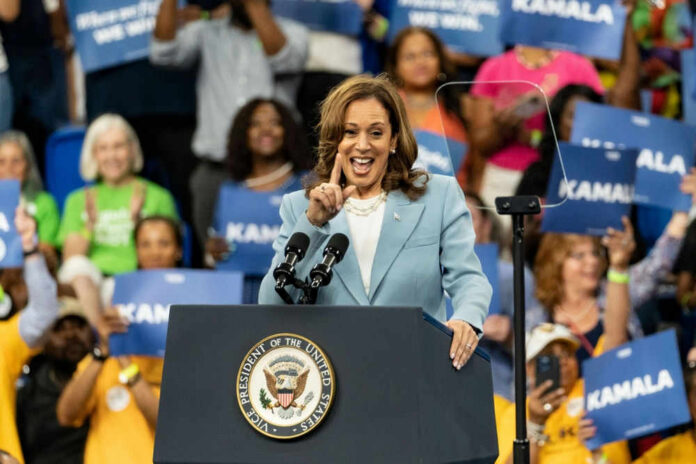
Kamala Harris is now openly fundraising to stop President Trump from choosing Supreme Court justices—before any seat is even vacant.
Quick Take
- Former Vice President Kamala Harris amplified a Demand Justice fundraising drive aimed at blocking potential Trump Supreme Court nominees.
- Demand Justice described a $3 million “startup” effort that could rise to $18 million if vacancies open on the Court.
- The push is tied to speculation about possible retirements of Justices Clarence Thomas (77) and Samuel Alito (76), though no vacancies have been confirmed.
- It underscores how Court confirmations have become a permanent political campaign, with outside money trying to shape the process.
Harris spotlights a preemptive campaign to block Trump nominees
Kamala Harris used social media to promote a fundraising appeal connected to Demand Justice, a liberal “dark-money” group that says it is preparing to oppose any new Supreme Court picks by President Donald Trump. Harris framed the stakes in personal terms, warning against Trump “hand pick[ing]” one or two additional justices. Demand Justice president Josh Orton outlined a plan that starts at $3 million and could scale far higher if seats open.
The key detail is timing: the fundraising push is not a reaction to an announced nominee or an actual vacancy. It is designed to pre-load resources and messaging so opposition can hit immediately if a retirement occurs. That approach reflects how confirmation fights have shifted from discrete Senate debates into year-round political warfare, powered by donors and professional advocacy networks operating largely outside the constitutional confirmation process voters can directly see.
Why the Supreme Court fight became a permanent political battlefield
Supreme Court politics escalated sharply after Justice Antonin Scalia’s death in 2016, when the Senate blocked President Obama’s nomination of Merrick Garland in an election year. President Trump then appointed Neil Gorsuch in 2017 and later filled the late Justice Ruth Bader Ginsburg’s seat with Amy Coney Barrett in 2020, cementing a 6-3 conservative majority. President Biden later replaced Justice Stephen Breyer with Ketanji Brown Jackson.
Those events hardened both parties’ incentives: conservatives view the Court as a backstop for constitutional limits and separation of powers, while Democrats increasingly treat the Court as a political institution to be fought over with campaign-style tactics. Demand Justice previously pushed for Breyer’s retirement during the Biden years. Now the group’s messaging centers on the possibility that older conservative justices—specifically Clarence Thomas and Samuel Alito—could retire, triggering a vacancy during Trump’s second term.
What’s known, what isn’t, and why Senate control still matters most
The constitutional reality remains straightforward: a president nominates and the Senate provides advice and consent. That means Senate control still determines outcomes more than any outside campaign, even if activist groups can shape public pressure. Legal experts emphasize that Senate numbers, not social-media virality, decide confirmations.
That said, preemptive opposition efforts can still affect the environment around potential nominees—especially by raising the political cost for senators who might otherwise focus on qualifications and judicial philosophy. For voters already exhausted by institutional gamesmanship, the bigger concern is normalization: if both parties treat the Court like another campaign battlefield, confidence in a branch designed to be independent will keep eroding, regardless of which side “wins” a given seat.
Conservative takeaway: outside money and “stop him” politics collide with constitutional norms
Harris’s message is explicit: “stop” Trump from influencing the Court by replacing justices, even though presidential appointments are a routine constitutional function. Critics in conservative media describe the approach as radical because it aims to choke off nominees through a donor-funded pressure apparatus, not through transparent debate about jurisprudence. It also highlights ongoing concerns about “dark money” groups attempting to steer judicial outcomes while operating at arm’s length from voters.
For conservatives who supported Trump expecting fewer foreign entanglements and a return to constitutional basics at home, it lands as another reminder that the left’s institutional strategy did not end with elections—it shifted into permanent resistance campaigns. The practical question for 2026 is whether Republicans respond by staying focused on Senate discipline and nominee quality, or whether the country slides further into a fundraising-driven arms race that turns constitutional appointments into never-ending partisan trench warfare.
Sources:
Jonathan Turley: Kamala Harris backs radical plan to block Trump SCOTUS picks
How Harris, Trump would put their stamp on the courts