
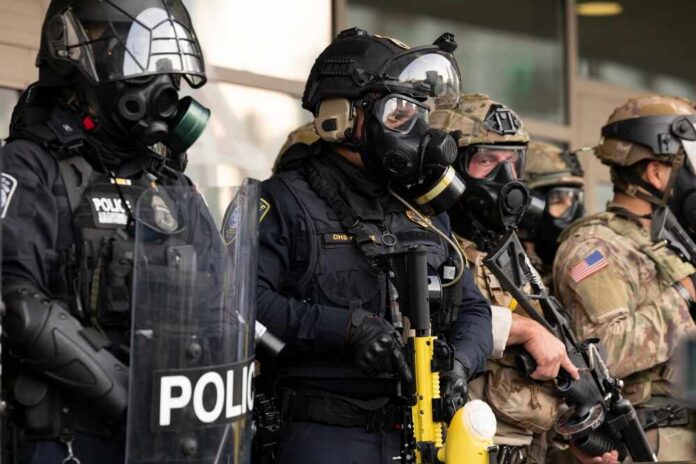
Trump’s decision to send ICE into America’s airports is the latest shutdown-era flashpoint—because Washington gridlock is now colliding with your basic right to travel without chaos.
Quick Take
- President Trump confirmed ICE agents will deploy to U.S. airports starting Monday, March 23, to help TSA manage long lines and staffing shortfalls tied to a partial DHS funding shutdown.
- Border czar Tom Homan said ICE will focus on non-screening tasks like crowd control and line management, while continuing routine immigration enforcement already conducted at airports.
- Officials and outlets reported the surge could involve hundreds of agents and up to 14 airports, with specifics still described as a “work in progress.”
- Transportation Secretary Sean Duffy suggested ICE agents may be trained to assist with X-ray-related duties, a point that conflicts with Homan’s public description.
- Democratic leaders and the TSA union warned about safety and mission creep, while some local officials said the focus is operational support—not immigration enforcement.
Shutdown Pressure Hits the TSA Checkpoint
President Donald Trump announced March 22 that ICE agents will begin deploying to airports on Monday, March 23, after reports of hours-long TSA lines during the spring break rush. Multiple reports tied the disruption to a partial government shutdown and a DHS funding standoff that has left TSA strained. The practical problem is simple: fewer screeners and longer lines. The political problem is sharper: funding fights now show up at the checkpoint.
Tom Homan, serving as the White House border czar, confirmed the plan and described it as a way to free TSA personnel from tasks that do not require specialized screening skills. Homan said ICE would help with line management and crowd control, not the X-ray screening process itself. That distinction matters for travelers who want speed without sacrificing security standards, and for critics who argue the administration is blurring lines between travel security and immigration enforcement.
What ICE Will Do at Airports—and What’s Still Unclear
Reporting described a targeted surge that could reach roughly 14 airports, with “hundreds” of agents potentially involved, though the final list and assignments were still being worked out. Homan’s explanation focused on support roles: moving crowds, managing queues, and relieving TSA officers so trained screeners can stay on screening tasks. The open question is whether airport-by-airport execution matches that narrow description once agents arrive and operations adapt to real-time conditions.
Transportation Secretary Sean Duffy added another layer of uncertainty by suggesting ICE agents are trained for X-ray work, a claim that conflicts with Homan’s message that ICE will not do screening. That contradiction is more than bureaucratic noise: TSA screening is a specialized function with defined procedures and accountability. When senior officials send mixed signals, it invites distrust and fuels the very political hysteria the public is tired of—especially when families are simply trying to fly.
Local Coordination and the “Not Immigration Enforcement” Promise
Atlanta became the clearest early example of how the deployment may look on the ground. Mayor Andre Dickens said ICE and Homeland Security Investigations personnel would be present at Hartsfield-Jackson Atlanta International Airport to support TSA operations and specifically framed the role as crowd control rather than immigration enforcement. That local messaging appears designed to calm travelers and reduce panic. It also underscores the delicate balance: airports need help, but communities fear a surprise shift in mission.
Union and Democratic Pushback Meets Hard Operational Reality
The TSA union president, Everett Kelley of AFGE, criticized the plan by arguing ICE is not trained for aviation security, warning of risks to the public if responsibilities expand beyond support tasks. House Democratic Leader Hakeem Jeffries also issued a stark warning about potential harm to travelers. The strongest factual footing for critics is the unresolved dispute about what ICE will actually do. When duties are unclear, critics can fill the gap with worst-case rhetoric.
At the same time, the operational reality driving the move is not disputed: TSA staffing has been strained during the shutdown, and long lines have already materialized. Reporting compared the moment to earlier shutdown-era travel disruptions, when TSA absences and low morale cascaded into delays. This time, the administration’s response uses an agency that remains funded while TSA struggles—an approach that may be politically provocative, but is straightforward in bureaucratic terms inside DHS.
What This Signals for Security, Borders, and Government Overreach Debates
The deployment sets a precedent conservatives and civil libertarians will both watch closely. If ICE stays in a limited assistance role, the move looks like a practical workaround to keep travel moving while Congress fights. If duties drift into screening functions, critics will argue security is being improvised. If enforcement visibility increases, supporters will say laws are being applied as written, while opponents will call it intimidation. The available reporting does not settle which path will dominate.
Prepare for Dem Meltdown: Homan Details How Help Is on Way As ICE Deploys to Assist TSA at Airportshttps://t.co/ijqLDaqDIg
— RedState (@RedState) March 22, 2026
The bigger takeaway is that shutdown politics now have immediate consequences for ordinary Americans, not just agency budgets. When DHS funding repeatedly fails, the system finds workarounds—and those workarounds can reshape norms fast. Trump is betting that visible action at airports highlights what he says is Democratic obstruction on border and DHS priorities. For travelers, the near-term test is simple: shorter lines without compromised screening standards, and clear rules that don’t change mid-trip.
Sources:
Homan Confirms ICE to be at Airports Starting Monday
ICE officers set to deploy to airports as delays mount; border czar Homan confirms
Transportation Secretary Duffy says ICE agents trained to assist TSA