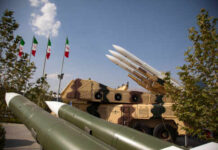
America is burning through high-end cruise missiles in Iran at a pace that raises a basic question conservatives are now asking out loud: how did “no new wars” turn into another open-ended Middle East fight?
Story Snapshot
- Multiple reports say the U.S. has fired more than 850 Tomahawk cruise missiles in roughly four weeks during Operation Epic Fury, prompting concerns about stockpile strain.
- The White House and Pentagon have publicly insisted the military has “more than enough” munitions to meet objectives, even as anonymous officials warn regional inventories are “alarmingly low.”
- Think-tank analysis and reporting point to slow replacement rates—only a few hundred Tomahawks produced annually—creating a multi-year replenishment timeline.
- Congress is watching closely, with reported resistance to a ground invasion as costs surge and the mission’s end state remains unclear.
Tomahawk “burn rate” becomes the new pressure point
Reports circulating since late March say U.S. forces have launched more than 850 Tomahawk cruise missiles at Iranian targets in about four weeks, with earlier tallies showing 500-plus Tomahawks in the first 16 days of fighting. The strikes are tied to Operation Epic Fury and a broader U.S.-Israel air campaign. The precise inventory is classified, but the reported pace is now driving the political debate at home.
Several outlets also describe the broader munitions picture: a claimed 11,294 munitions expended in the opening 16 days, paired with a price tag reported at roughly $26 billion. Those numbers matter because Tomahawks are not disposable battlefield “ammo.” They are strategic assets designed for opening salvos and high-value targets, not a long-duration substitute for a defined political strategy or a negotiated end point.
Administration reassurance vs. anonymous alarms inside the system
White House press secretary Karoline Leavitt and Pentagon spokesman Sean Parnell have both offered public confidence, arguing the U.S. has sufficient munitions “to achieve goals — and beyond” and that the military has what it needs on the president’s timeline. That reassurance is politically important for a second-term Trump administration now fully accountable for outcomes, not just rhetoric, in a war with clear escalation risks and no obvious off-ramp.
At the same time, reporting citing Pentagon officials describes Middle East stockpiles as “alarmingly low” and says planners are weighing reallocating reserves and accelerating procurement. That tension is not a minor messaging dispute; it goes to constitutional and strategic fundamentals. If the executive branch asks the country for patience, money, and risk acceptance, conservatives reasonably expect clear objectives, clear constraints, and honest accounting about readiness tradeoffs in other theaters.
Replacement timelines expose a bigger industrial bottleneck
Tomahawks are produced by Raytheon and are typically launched from U.S. ships and submarines to strike from standoff range, reducing risk to pilots while enabling deep precision attacks. The problem is throughput. Reporting and analysis emphasize that production runs at only a few hundred per year, and a RUSI assessment suggests replenishing hundreds of expended missiles could take five years or more. That timeline collides with the reality of a world where deterrence demands depth, not headlines.
Those replenishment constraints also sharpen concerns about priorities beyond Iran. Analysts cited in reporting have warned that drawing down finite precision inventories could weaken preparedness for peer competition, where target sets and required volumes are dramatically larger. None of this proves the U.S. is “out” of Tomahawks, and some dramatic phrasing online overstates the case. It does, however, underscore a measurable mismatch between high-intensity consumption and slower industrial replacement.
MAGA division: supporting Israel without signing up for regime-change math
The conflict’s politics are shifting because the coalition that returned Trump to office is not unified on another Middle East campaign. The public record in reporting shows Israel conducting strikes connected to Tehran infrastructure and missile production sites while the U.S. provides key strike capacity and regional posture. For many pro-Trump conservatives, support for Israel’s security has historically coexisted with deep skepticism toward nation-building and indefinite deployments that drain readiness and drive borrowing.
Congressional dynamics also matter. Reporting notes oversight concerns and opposition to a ground invasion from leadership figures, alongside discussion of adding up to 10,000 ground troops while an invasion has not occurred. For constitutional conservatives, the unresolved issue is not merely “hawk vs. dove.” It is whether the mission stays bounded, whether war powers are respected through meaningful debate, and whether Americans are being leveled with about costs, risks, and the likely duration.
Sources:
U.S. launches over 850 Tomahawk cruise missiles in Iran conflict
US, Israel ‘burning through’ Tomahawk, interceptor missiles in Iran
US uses hundreds of Tomahawk missiles on Iran, alarming some at Pentagon
U.S. Is Burning Through Tomahawk Cruise Missile Stockpile At A Alarming Rate: Report