
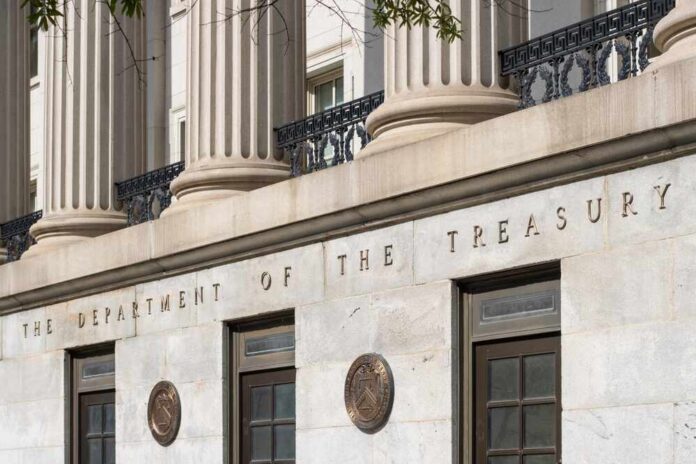
The same federal student-loan machine that ballooned to $1.7 trillion is now being shifted to the Treasury—raising a hard question: is Washington finally cleaning up the mess, or just moving it to a new building?
Quick Take
- The Trump administration announced a March 20, 2026 interagency agreement moving management of the federal student-loan portfolio from Education to Treasury, starting with defaulted loans.
- Roughly 9 million borrowers are in default, and Treasury’s collection tools and data access could make enforcement faster and more centralized.
- The plan rolls out in phases and is framed by the administration as a first operational step toward dismantling the Department of Education.
- Officials promise a “seamless” change for borrowers, but consumer advocates and Democrats warn about confusion, service gaps, and new red tape.
Treasury takes the wheel on defaulted loans first
The Department of Education and the Treasury Department announced an agreement to transfer management of the $1.7 trillion federal student-loan portfolio, with the first wave focused on defaulted accounts. The administration is starting where the system is most visibly broken: about 9 million borrowers are currently in default, generally defined as 270-plus days past due. Treasury is expected to take over operational responsibility for collections and support tied to these defaulted debts.
Education Secretary Linda McMahon argued the Education Department failed to manage the portfolio effectively and said Treasury’s finance expertise can deliver “functioning programs” after decades of mismanagement. Treasury Secretary Scott Bessent echoed that theme, describing the shift as a serious cleanup effort and a push for better stewardship of taxpayer dollars. Those statements set expectations high, but they also put a spotlight on whether results will match the rhetoric.
A phased plan that quietly advances a bigger goal
The transfer is structured in three phases. Phase one moves defaulted portfolios to Treasury. Phase two expands Treasury’s operational support to non-defaulted loans, limited by what is “practicable” and allowed by law. Phase three involves Treasury assisting with school eligibility enforcement for federal student aid. The phased structure reads like a technical project plan, but it also functions as a roadmap for stripping major responsibilities from the Education Department.
Administration officials described the transition as deliberate and designed not to “break anything,” with borrowers supposedly seeing no difference. That promise matters because federal student-loan servicing has a long history of vendor churn, confusing notices, and inconsistent guidance. A “seamless” change is possible in theory, but the research available does not include a public cost analysis, a detailed timeline for later phases, or clear operational benchmarks that would let taxpayers measure success.
What changes for borrowers: enforcement capacity versus continuity risks
Treasury brings real enforcement advantages. With access to tax data and established collection infrastructure, Treasury can verify income and pursue default recovery more efficiently than an education-focused agency. For conservatives who want competence and accountability, the argument is straightforward: a $1.7 trillion portfolio is effectively a massive financial institution, and financial discipline should not be optional. Still, efficiency claims are difficult to audit right now because the administration has not provided specific transition cost figures.
Consumer advocates focused less on ideology and more on execution risk. The National Consumer Law Center’s Kyra Taylor questioned how Treasury staff will be trained on borrower rights under the Higher Education Act and how agencies will keep communications clear during a confusing handoff. Those are practical concerns, not talking points. If notices are wrong, if call centers are inconsistent, or if appeals are mishandled, ordinary borrowers can get trapped in bureaucracy—exactly the kind of unaccountable government runaround voters are tired of.
Political blowback: “efficiency” claims meet skepticism about new red tape
Democratic lawmakers, including Sen. Patty Murray of Washington, argued the agreement could create “pointless new red tape” while threatening services students rely on. That criticism may land with borrowers who have lived through shifting repayment rules and changing servicers. At the same time, the administration’s case is that the existing setup already failed: nearly a quarter of borrowers are in default, and the portfolio has grown to a level that makes mismanagement costly for taxpayers and destabilizing for families.
For conservatives watching Washington in 2026—especially those already fed up with overspending, inflationary fiscal habits, and government systems that never seem to work as promised—this transfer is a test. If Treasury delivers clearer rules, consistent servicing, and measurable reductions in default without trampling borrower protections, it will look like overdue reform. If the change becomes another opaque federal reshuffle, skepticism about bureaucratic power will only deepen.
Sources:
Education Department lays out plan to move student loan portfolio to Treasury (Politico)
Trump Administration Begins Moving Student Loan Responsibilities to Treasury Department (NASFAA)