
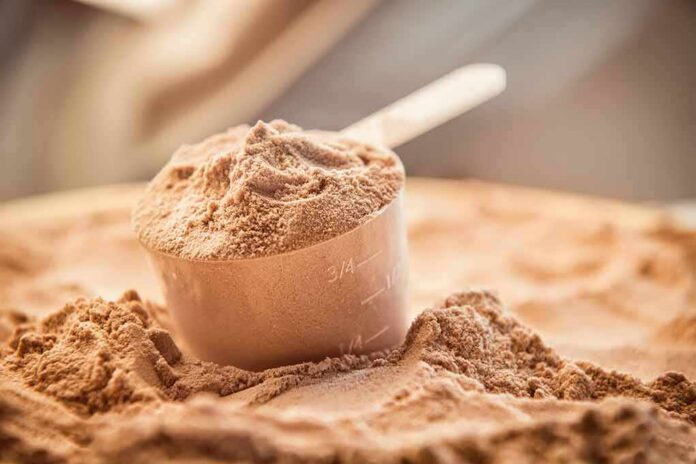
America’s new protein craze is turning our dairy plants into quiet mega-factories for whey powder, flooding the country with more cheese than families ever asked for.
Story Snapshot
- U.S. cheese production has surged to record highs as processors chase profits from whey protein, not the cheese itself.
- Government data and industry reports show billions in new plants built around extracting high-value whey from every gallon of milk.
- Cheap surplus cheese risks undercutting family farmers while padding margins for big processors and export traders.
- Conservatives who care about food security and rural America should watch how this quiet shift in dairy economics plays out.
Whey Protein Craze Is Driving Record Cheese Output
United States government dairy reports show that total cheese production hit repeated records in 2024 and 2025, reaching about 14.8 billion pounds in 2025, roughly 4 percent above the year before. In May 2026, monthly cheese output climbed to 1.28 billion pounds, about 2 percent higher than May 2025 and a fresh all‑time high. Industry analysts link this growth to the nation’s hunger for protein powders, which come from whey, the liquid byproduct created every time plants make cheese.
America’s “protein‑maxxing” trend is reshaping dairy economics from the inside out. Major outlets report that booming demand for whey protein is “helping push U.S. cheese production to record highs,” as processors ramp up runs mainly to capture the whey stream. A New York newspaper likewise describes whey as moving from a minor line item to a core profit driver in the milk check farmers receive. That shift means the real money in many plants is no longer in the cheese you see in the dairy case.
How A Byproduct Became The Main Moneymaker
The United States Department of Agriculture’s Economic Research Service explains that cheese is the largest manufacturing use of milk and that whey naturally comes off as a byproduct every time milk is turned into cheese. For decades, this watery liquid was often treated as waste, fertilizer, or low‑value animal feed. But improved filtration and drying technology now let plants turn that once‑cheap byproduct into high‑protein powders for shakes, bars, and diet products, where profit margins are far richer than in basic cheddar blocks or shredded mozzarella.
Industry and land‑grant university economists report that in some plants, whey streams now deliver as much or more revenue than the cheese itself. A Wisconsin‑based processor cited by a Midwestern station said production of high‑protein whey powders soared from just a few million pounds in the early 2000s to tens of millions of pounds per month as demand exploded. One analysis notes that whey’s share of the typical monthly milk payment to farmers has risen several fold over the past two decades, at times topping 10 percent. That kind of payoff pushes processors to design whole plants around protein capture.
New “Cheese” Plants Built As Protein Factories
Trade groups and industry trackers describe a wave of investment in new cheese and whey facilities across at least 19 states, with more than 11 billion dollars in projects committed between 2025 and 2028. These plants are technically labeled as cheese facilities, but analysts warn they function in practice as protein extraction factories that happen to produce cheese as a side stream. One report from a dairy outlet notes that as cheese production ramps up, so does whey production, because the two are inseparable at industrial scale.
The structure of the system means companies cannot simply build a stand‑alone whey plant; they must run vast volumes of milk through cheese vats to create the liquid whey they then filter into concentrate and isolate powders. Federal dairy reports show dry whey and lactose output climbing alongside cheese, while processors divert more flows into higher‑value whey protein concentrates and isolates instead of low‑grade dry whey. In plain terms, every extra pound of protein powder for gym‑goers or diet programs brings with it about ten pounds of cheese that must find a home somewhere in the food chain.
What This Means For Farmers, Families, And Food Security
Government statistics show cheese production has roughly doubled since the mid‑1990s, rising from around 6.9 billion pounds in 1995 to more than 14 billion pounds by 2024. Per‑person cheese consumption has also grown steadily over decades, helped by fast food, frozen meals, and snack products. But recent data show domestic demand alone is not enough to absorb the latest surge, so exporters are leaning on foreign markets in Latin America and Asia to move the extra supply at discounts. That puts another piece of America’s food system in the hands of global trade flows.
Conservative readers who care about rural America and self‑reliance should track who wins and who loses from this quiet shift. Large processors and multinational traders gain from selling high‑margin whey powders worldwide, while cheap surplus cheese can weigh on prices paid to family dairy farms already squeezed by high feed, fuel, and interest costs. At the same time, more processed cheese flowing into ultra‑processed foods may not match the wholesome, local food culture many families want, even as they pay for the same milk twice through higher grocery bills and federal farm programs.
Sources:
zerohedge.com, dairynews.today, usdec.org, nass.usda.gov, thinkusadairy.org, en.edairynews.com, esmis.nal.usda.gov, fmmacentral.com, ams.usda.gov, cheesefromtheusa.org, facebook.com, blogs.extension.iastate.edu, haskell.com, cnbc.com, thecounter.org, linkedin.com, cheesereporter.com, farms.extension.wisc.edu