
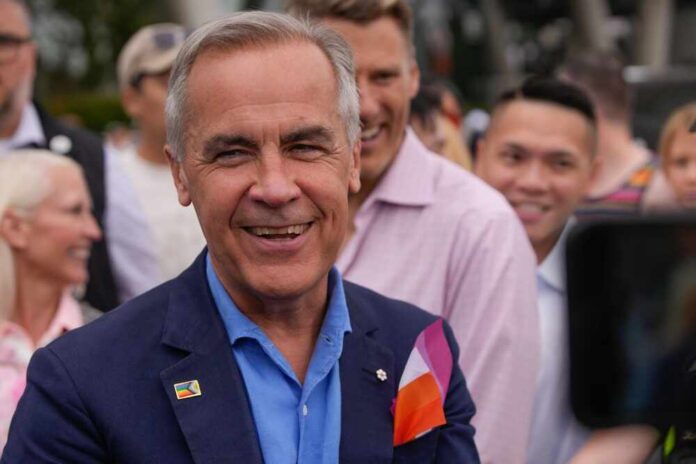
Canada’s prime minister just called decades of close U.S. economic ties a “weakness”—a blunt warning that America’s neighbors are preparing for a less integrated, more transactional North America.
Quick Take
- Prime Minister Mark Carney said Canada’s long-standing economic closeness with the U.S. has shifted from a strength to a “weakness that must be corrected.”
- Carney linked Canada’s pivot to U.S. tariff increases described as reaching levels not seen since the Great Depression, intensifying uncertainty for key Canadian industries.
- Ottawa’s “Canada strong” approach emphasizes diversification, including claims of 20 new trade deals across four continents in the past year.
- Autos, steel, and lumber were highlighted as sectors exposed to trade disruption, with investment decisions and worker security affected by ongoing uncertainty.
Carney’s message signals a strategic break with “business as usual”
Prime Minister Mark Carney delivered the message in an April 19, 2026 video address titled “Forward Guidance with Prime Minister Mark Carney,” lasting about 10 minutes and distributed on social media. Carney argued that what Canadians long treated as a reliable advantage—deep integration with the U.S. economy—now functions as a vulnerability. He framed the problem as dependence on a single foreign partner whose policy shifts Canada cannot control.
Carney’s line that Canada must “take care of ourselves” landed as more than a campaign-style slogan. It was a governing thesis: Canada should reduce exposure to U.S. political decisions by widening its market access and investment sources. For Americans watching from the Trump administration’s second term, the immediate takeaway is not the rhetoric but the direction—Canada is publicly preparing for a future where the U.S. uses trade leverage more aggressively and predictably.
Tariffs and “Great Depression” comparisons raise the stakes for industries
Carney tied the change in Canadian strategy directly to U.S. trade policy, saying the United States has “fundamentally changed its approach to trade,” with tariff levels compared in reporting to those last seen during the Great Depression. The practical impact concentrates in sectors where cross-border supply chains are deeply intertwined. Canada singled out automobiles, steel, and lumber as industries facing heightened risk, with uncertainty affecting both workers and investment planning.
It does not quantify job losses, price changes, or GDP impacts tied to these tariffs, and no U.S. official response was included in the cited coverage. Still, Carney’s emphasis on uncertainty matters because uncertainty itself can freeze capital decisions. When companies cannot predict market access or input costs, they delay expansions, re-route production, or seek alternative suppliers. That dynamic can weaken the integrated North American model that both countries relied on for decades.
“Canada strong” is a sovereignty pitch built around diversification
Carney described a government-led push to diversify trade and investment away from the U.S., branding the approach “Canada strong.” In the materials cited, his government claims it has signed 20 new trade deals across four continents in the past year and is pursuing new partnerships designed to open additional markets. The address also described “big structural changes” intended to reduce reliance on U.S.-centric trade patterns and encourage domestic job creation.
Key details remain unclear: the specific countries involved, the sectors covered, and whether the deals are fully ratified agreements or preliminary frameworks. Those distinctions matter because diversification strategies can look strong in a headline while taking years to produce measurable outcomes. Even so, the political signal is unmistakable—Canada is telling its citizens that the old assumption of stable U.S. access can no longer anchor national economic planning.
The War of 1812 symbolism shows how economic policy becomes identity politics
One striking moment emphasized how Canada’s trade pivot is being sold not merely as economics, but as national identity. Reporting noted Carney held up a toy soldier depicting General Isaac Brock, a figure associated with Canada’s defense against a U.S. invasion during the War of 1812. That symbolism suggests Carney is framing modern trade conflict in the language of sovereignty, resilience, and independence—an appeal designed to unify Canadians around self-reliance.
For U.S. conservatives who favor America First trade tools, Canada’s rhetoric is a reminder that leverage cuts both ways. Tariffs can drive negotiations, but they can also push partners to build workarounds that endure after the immediate dispute fades. For U.S. liberals worried about inequality and economic insecurity, the episode highlights a shared concern: ordinary workers bear the brunt when policy uncertainty collides with tightly connected supply chains. Either way, Carney’s message underscores a broader reality many Americans already feel—government decisions increasingly disrupt the stability families and small businesses need to plan their futures.
Sources:
Carney says Canada’s previous relationship with U.S. a weakness that must be corrected
Carney says Canada’s US ties have become a weakness