
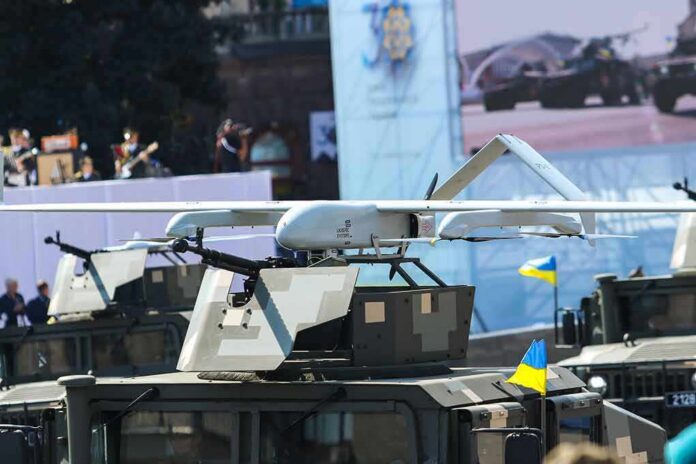
Ukraine’s drone war has turned the front line into a deadly machine-speed battlefield, and the change is already reshaping how modern armies fight.
Quick Take
- Drone strikes are being credited with a huge share of casualties and target destruction in Ukraine.
- Ukraine has used drone scale and range to regain ground and disrupt Russian supply lines.
- Military analysts still say drones are a force multiplier, not a stand-alone war winner.
- New sea-based and AI-enabled systems show how fast Ukraine is adapting its drone fleet.
Drone Power Is Driving the Battlefield
Reporting on the war shows that drones now sit at the center of combat in Ukraine. A 2024 report from the Center for a New American Security said drones had the biggest effect at the tactical level and were often used to guide artillery fire. Later coverage from the Council on Foreign Relations said drones were responsible for 75 to 85 percent of front-line casualties and that Ukraine’s drone scale helped force Russian units to spread out and protect supply lines.
That shift matters because it changes how both sides move, hide, and resupply. Reuters reported in February 2026 that drones had transformed the combat landscape, raising the risk for tank movements, evacuations, and troop movement near trenches. The same reporting said drone-related casualties surged from below 10 percent of total losses in 2022 to as high as 80 percent by the prior year, showing how fast this weapon class moved from support tool to battlefield danger.
Ukraine’s Gains Reflect Scale, Not Magic
Ukraine’s drone buildup has also produced real battlefield gains. The Council on Foreign Relations reported that Ukraine retook seventy-eight square miles in five days in February 2026, with drone operations playing a major role in that advance. The same report said Ukraine expanded its strike reach to thirty to one hundred kilometers behind the front, which helped pressure Russian logistics and command posts. That is not a miracle weapon story. It is a scale story.
Even the more pro-drone studies in the research package stop short of calling drones a replacement for combined arms. The Australian Army’s research center said drones have been important because they give Ukraine an asymmetric edge, but they work best when tied to artillery, intelligence, and ground combat. A West Point analysis said drones have restricted movement and helped create a more static war, but have produced limited strategic effect for either side.
New Platforms Show Fast Adaptation
Ukraine is also adapting drones in ways that would have seemed unlikely a few years ago. A report tied to Ukraine’s military intelligence service said the Magura naval drone platform was modified in late July to launch first-person view attack drones from the sea onto land targets in occupied Crimea. The operation reportedly struck radar equipment, showing that Ukraine is not just building more drones. It is turning one unmanned system into a carrier for another.
Analysts at the Center for Strategic and International Studies said Ukraine is also pushing toward artificial intelligence-enabled unmanned warfare, with human oversight still central to engagement decisions. That matters because it shows where the next fight is headed. But it also shows the limits of the current one. Even supportive analysts say autonomy is still partial, not total, and that battlefield success still depends on human operators, repair crews, and supply chains.
The Real Lesson for Future Wars
The clearest lesson from Ukraine is not that drones have made every other weapon obsolete. It is that cheap, abundant drones can punish massed forces, expose weak logistics, and make the battlefield far more lethal. Hudson Institute reporting described drone warfare as a machine-speed system built around rapid kill chains and constant surveillance. But Army and West Point-linked analysis both warn that drones cannot hold ground or win a war by themselves.
That warning matters for the United States and its allies. A military that ignores drones will fall behind. A military that treats drones as a total substitute for artillery, armor, infantry, and logistics will make the same mistake from the other direction. Ukraine’s war shows both truths at once. Drones have changed warfare at the tactical level, but the side that can combine drones with traditional combat power still has the best chance to turn damage into durable gains.
Sources:
19fortyfive.com, researchcentre.army.gov.au, hudson.org, osw.waw.pl, understandingwar.org, reddit.com, csis.org, mwi.westpoint.edu