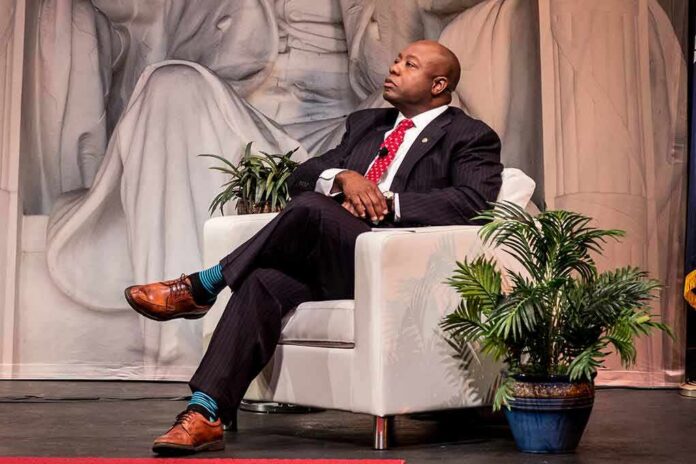
CNN’s challenge to Tim Scott over Abdul El-Sayed’s full name put a sharp spotlight on a campaign tactic that critics say was meant to signal religion, not policy.
Quick Take
- Senator Tim Scott denied that the ads were meant to suggest El-Sayed is Muslim.
- CNN’s Manu Raju asked whether the full name was a coded reference to religion.
- Scott said the ads were aimed at El-Sayed’s record and what he “stands for.”
- El-Sayed and critics said the full-name use echoed an identity-based attack pattern.
Scott Rejects the Islamophobia Charge
During the CNN exchange, Manu Raju pressed Scott on whether the ads were trying to tell voters, “he’s Muslim.” Scott answered, “Not at all,” and said the focus was on El-Sayed’s own words and positions. He added that El-Sayed had called himself a “most dangerous candidate,” and that Republicans should “trust his words, not ours.” The exchange became a fight over intent, not just wording.
Scott also gave a broader defense of the ad language. He said the campaign was not targeting El-Sayed’s faith, but rather his record on issues Republicans viewed as disqualifying. In the same interview, Scott tied El-Sayed to Hamas, Hasan Piker, defunding police, and abolishing Immigration and Customs Enforcement. That made his case plain: the ads were built around political attacks, not a religious signal.
Why the Full Name Drew Fire
The controversy started because the ads used El-Sayed’s full legal name, Abdulrahman Mohamed El-Sayed, instead of the name he uses publicly. CNN’s Raju asked why Republicans would not simply use “Abdul El-Sayed” if the goal was ordinary voter identification. That question landed because the full-name choice came from a campaign already using harsh language about El-Sayed’s politics, which made critics read the wording as deliberate.
Coverage from The Independent and Inkl said the National Republican Senatorial Committee was repeatedly highlighting El-Sayed’s full name and that critics saw it as an Islamophobic tactic. El-Sayed himself said the wording echoed attacks used against Barack Obama, pointing to a familiar pattern in modern campaign politics. Those reports do not prove intent on their own, but they explain why the naming choice drew so much attention so fast.
What the Public Record Shows
The public record supports two things at once. First, Scott clearly denied that the ads were meant to attack El-Sayed’s Muslim faith. Second, the repeated use of the full legal name, combined with the harsh framing around religion-coded topics, gave critics a basis for suspicion. What the record does not show is an internal memo, script note, or test result proving the name choice was designed as a religious signal.
CNN is melting down over the GOP using Abdulrahman Mohamed El Sayed's full name, worrying Michigan voters will see he's a Muslim
CNN: Your ad uses his FULL name. He goes by Abdul El Sayed. Are you saying, hint hint, he's Muslim?!
TIM SCOTT: We're saying he says he's the most… pic.twitter.com/wscJlG7iUj
— Trumpusa1 (@Trumpusa1A1) August 11, 2026
That gap matters. Without internal campaign documents, the dispute rests on public messaging, interviews, and outside interpretation. Scott’s defenders can point to his policy-based explanation. Critics can point to the full-name emphasis and the surrounding language about identity and faith. For readers, the safest reading is that the ads were aggressive political attacks, while the religious intent claim remains an inference rather than a proven fact.
Sources:
twitchy.com, youtube.com, independent.co.uk, inkl.com, instagram.com, washingtonexaminer.com