
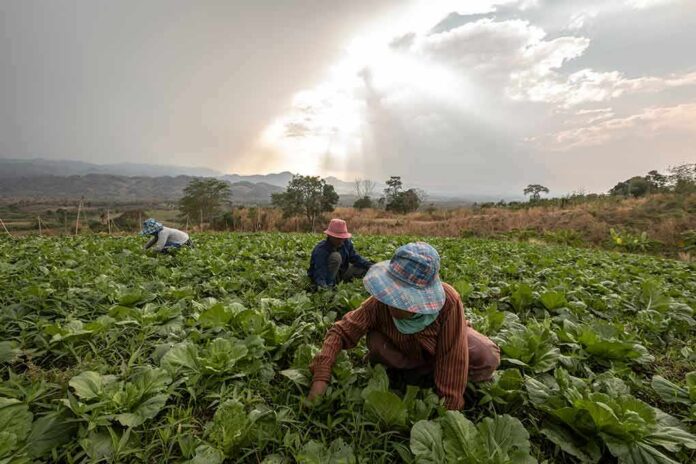
Japan’s farm crews are moving harvests into the night to avoid deadly daytime heat, rewriting work hours to stay alive.
Story Highlights
- Reuters documented farmers near Tokyo shifting harvests and chores to nighttime after heatstroke risks rose.
- Midday outdoor heat above 95 F can drive greenhouses past 104 F, making work dangerous.
- A poultry farmer reported losing over 500 hens in a past heatwave and now feeds at night to reduce losses.
- Around 70% of Japan’s farmers are 65 or older, heightening heat vulnerability.
Farmers Shift to Night Work to Protect Lives
Reuters reported that growers near Tokyo now harvest and do heavy tasks after dark to avoid lethal heat. Flower farmer Motoaki Iijima said he changed schedules to protect workers after heat rose year after year and a staffer suffered heatstroke. He said the team now focuses on night harvests and chores when air is cooler and safer. The report described this as part of a broader move across farm types, from flowers to asparagus and eggs.
Reuters detailed the heat mechanics pushing this change. When outside temperatures top 95 degrees Fahrenheit, greenhouse interiors can spike over 104 degrees. That turns midday into a high-risk window for collapse, mistakes, or worse. Moving labor to cooler hours cuts that risk at once. It also helps crops that wilt in extreme heat. The farmers are not waiting on new gear or rules. They are changing time, because it is the fastest fix.
Livestock Losses Drive New Routines
Heat does not only hurt people. It hits animals and yields. Poultry farmer Tedsuya Usuba told Reuters he lost more than 500 laying hens during a three-day heatwave six summers ago. He now wakes the flock and feeds at night, when air is cooler and stress is lower. That simple shift helps birds eat and drink when their bodies can handle it. It is a low-cost change that protects fragile inventory and keeps food supply steadier.
Older farmers face the hardest choices. Reuters reported that around 70 percent of Japan’s farmers are 65 or older, which raises the danger from extreme heat. Older workers dehydrate faster, sense heat changes less, and have higher baseline health risks. Night work reduces peak exposure and buys them time. Local guidance in Tokyo also urges cooler-hour work, buddy systems, and frequent hydration, underlining that timing and teamwork save lives.
What This Shift Says About Work, Safety, and Food
The switch to night is a clear example of how people adapt first with the tools they have. Time is cheap to change. Labor hours can move tonight or tomorrow. Fans, shade, and spot coolers help, but few fixes beat avoiding the hottest hours. Reuters framed this as a growing pattern across farm types, not a one-off tale. The goal is simple: keep workers safe, protect animals, and prevent crop losses while meeting delivery schedules.
Japanese farmers are shifting more work into the night as extreme heat worsens
Japan lost an estimated 9.26M potential agricultural work hours to heat exposure in 2024, while about 70% of farmers are over 65
climate risk is becoming a labor constraint too
— Ryzm (@Goeun_6121) August 18, 2026
Limits in the current reporting remain. The Reuters feature cites named farmers and shows compelling cases, but it does not yet quantify how many farms switched, or by how much productivity changed. It also does not present nationwide adoption counts. Still, the reasons are plain and well documented: dangerous daytime heat inside and outside greenhouses, a vulnerable and older workforce, and a proven way to cut risk by working when it is cooler.
Sources:
youtube.com, reuters.com, tradingview.com