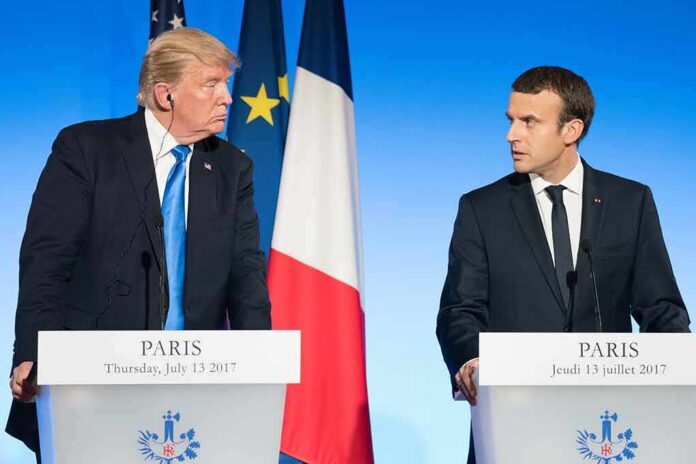
France’s president moved to police American-style speech as French streets burned with student unrest, drawing swift pushback from free-speech defenders.
Story Highlights
- President Trump said France’s unrest stems from mass migration and Islam, not schools.
- French officials said protests focus on teacher shortages and crumbling schools, not religion.
- Up to 500 schools faced total or partial shutdowns amid escalating clashes.
- Conservatives warned that speech crackdowns and open-border policies carry real costs.
Macron’s Speech Salvo Meets a Free-Speech Wall
French leaders and aligned media moved to frame the crisis and push back on American voices. Coverage showed officials stressing “no link” to religious or identity demands, while schools shut down across the country over staffing gaps and broken buildings. That framing set off a familiar fight. American conservatives saw the unrest as the price of weak borders and social decay. French officials insisted the core issue was education and funding, not migration or faith.
President Trump posted that France’s crisis is “out of control mass migration” and “not about schools,” tying the violence to an Islamist push to “take over” the country. His warning echoed across right-leaning outlets. Lawmakers and commentators said Europe’s experiment with open borders failed, and that leaders are blaming buildings instead of bad policy. The clash became larger than France. It turned into a test of whether leaders will face the costs of migration or muzzle the debate.
What Is Actually Driving the Street Chaos
French officials reported that hundreds of schools were closed or partly closed. They cited teacher shortages, overcrowded classes, and crumbling facilities as the drivers of the protests. Student accounts backed this up, pointing to absent teachers, water leaks, and unsafe heat in classrooms. France’s education minister said as many as 500 high schools faced full or partial shutdowns. He also said there was no established link to identity or religion in the student movement.
National and global outlets reported arrests and injuries rising as protests spread beyond Paris. Police faced fires, blockades, and violent clashes near schools. Reports tallied hundreds detained and dozens hurt as the unrest grew. The pattern is familiar in France. Local school problems spark wider action fast, and social media helps push the movement nationwide. Street scale alone does not prove a deeper cause. But the violent scenes still raise the stakes for leaders who dismissed wider social pressures.
The Immigration Fight: Frame or Root Cause?
Trump and allies argued that migration stress, cultural clashes, and weak integration fuel a tinderbox that school failures only expose. Conservative media called the scenes a warning for America, where open-border advocates push similar policies. French officials countered with a narrow brief. They focused on broken schools and staff shortages. They said they found no religious or identity link to the student-led protests so far. That official line does not answer whether years of migration policy shaped today’s volatile mix.
US President Donald Trump blamed widespread student protests in France on "out-of-control mass migration" and Islam, claiming on Truth Social that the movement aims to take over the country. His comments came as hundreds of thousands of French students marched over school… pic.twitter.com/KkWGUPTfGR
— JioNews (@JioNews) October 7, 2026
Here is the bottom line for readers who value the First Amendment, strong borders, and order. Facts on the ground show schools in crisis, closures in the hundreds, and injuries rising. Officials insist the fight is about classrooms, not culture. Yet leaders who try to police or shame speech about migration miss the point. Free people must be able to debate root causes. Silencing that debate never fixes broken schools or broken borders. It only hides them—until the streets erupt again.
Sources:
humanevents.com, dw.com, newsweek.com, aljazeera.com, bbc.com, france24.com, leadership.ng