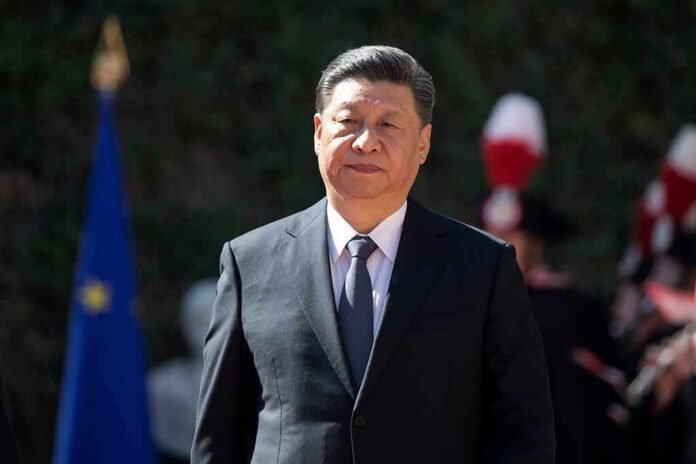
China’s Xi Jinping broke precedent to greet President Trump on the tarmac, a rare honor that signaled clear diplomatic weight for the United States ahead of a high-stakes summit.
Story Highlights
- Xi personally welcomed Trump at the airport with a handshake and brief embrace in a rare move.
- Russian President Vladimir Putin was received by top official Cai Qi, not by Xi himself.
- Xi’s gesture mirrored Trump’s earlier airport welcome for Xi in Maryland, showing reciprocity.
- The greeting set the stage for a first-ever three-way summit among Trump, Xi, and Putin.
Xi’s Unusual Tarmac Welcome For Trump
Reuters reported that Xi walked onto the tarmac to meet President Trump, shook his hand, embraced him briefly, and exchanged words before motorcades rolled out. The wire service described the move as a rare gesture, with Xi returning the courtesy Trump showed when he personally welcomed Xi at Joint Base Andrews in September. Agence France-Presse reported the same scene and quoted Xi seeking an “in-depth exchange of views” and a “constructive, strategically stable relationship” with the United States.
The New York Times, tracking live updates, placed the greeting just ahead of the expected Trump‑Xi‑Putin trilateral in Shenzhen. It also confirmed that Putin’s arrival drew a senior welcome, but not by Xi, highlighting the difference in who stood on the runway for each leader. These details mark a deliberate piece of summit choreography. The visual message was simple and public: Xi engaged Trump one-on-one in a way he did not with Putin at the airport.
How Putin Was Received, And Why That Matters
Putin did not get a cold shoulder. He was met by Cai Qi, one of China’s most powerful officials and a member of the Politburo Standing Committee, which is the top decision-making body in China. That still ranks as a high honor. But the contrast is real. Trump got Xi. Putin got Cai. For skilled diplomats, the identity of the greeter is the message. In this case, the message placed the United States relationship in the spotlight on day one of the summit.
That said, the evidence shows protocol, not a declaration of allegiance. No Chinese official said Xi favored Washington over Moscow. Reports stressed reciprocity as the core reason for the greeting, tying it to Trump’s earlier personal welcome for Xi in the United States. The symbolic edge for America is clear from the optics. The strategic meaning beyond optics remains open until talks and outcomes show more.
Reciprocity, Optics, And Real Leverage
Xi’s public message leaned on reciprocity, a key idea in Chinese statecraft. Reuters and Agence France-Presse framed the airport moment as payback for Trump’s Andrews welcome, not as a snub of Russia. That framing answers why Xi came to the runway but leaves the “so what” to the agenda, the seating, and any deals. For conservatives who demand strength, the scene showed something important: respect for the office and deference to a leader who puts America first.
Shenzhen, China: World leaders, including US President Donald Trump, Russian President Vladimir Putin, and Chinese President Xi Jinping, pose for a family photo at the 33rd APEC Economic Leaders' Summit.#putin #trump #xijinping #apececonomicsummit #shenzhen #china pic.twitter.com/FBi3Ptz6ji
— News18 (@CNNnews18) November 19, 2026
Analysts and media can argue over symbolism for weeks. What cannot be argued is the fact pattern. Xi met Trump at the plane. Putin met Cai. The three then appeared together at formal events, underscoring that Beijing wants to look like the convening power of a great-power triangle. For Americans watching energy prices, trade frictions, and tech controls, the key test is whether this respect translates into better terms, fair trade, and fewer globalist strings.
What Comes Next At The Trilateral Summit
The unusual three-way summit gives China a stage, but it also gives the United States leverage if it uses it. With the world watching, Beijing gains status by hosting. Washington can use that spotlight to press for clear wins on trade fairness, intellectual property, critical minerals, and the rules around artificial intelligence. Xi’s warm greeting sets a tone. President Trump’s job is to turn that tone into outcomes that help American workers and families.
The limits are real. Russia was not pushed to the sidelines. Reports noted cordial greetings among all three leaders at later events, and nothing yet shows a policy shift by China away from Moscow. But ceremonies exist for a reason. Protocol can open doors or close them. If the personal welcome helps drive even small steps on de-escalation or market access, the optics will have done useful work. If not, it remains a clear show of respect — and a reminder that strength gets noticed.
Bottom Line For Readers
The tarmac moment tells us two things. First, respect follows reciprocity. When America shows strength and clarity, others respond. Second, optics can signal room for a deal, but only firm negotiating delivers one. President Trump arrived to a rare honor. Now comes the hard part: locking in policies that protect American industry, defend our strategic edge, and reject globalist schemes that push costs onto U.S. families. That is the standard to judge this summit by.
Sources:
afp.com, nytimes.com, rmb.reuters.com