
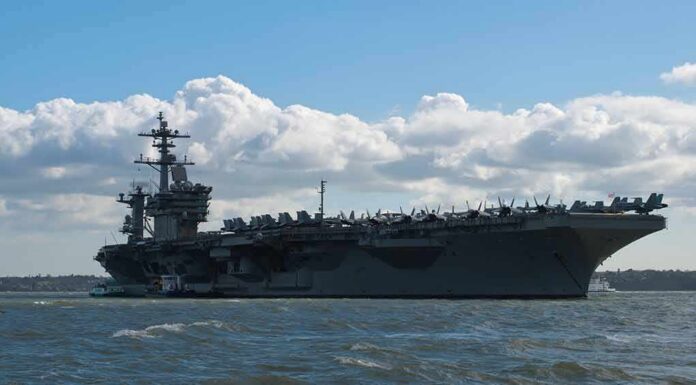
A third U.S. aircraft carrier has entered the Central Command region, signaling hard power in a dangerous neighborhood.
Story Highlights
- USS Theodore Roosevelt entered the Central Command area on November 15, 2026, according to U.S. officials.
- The move brings three U.S. carrier strike groups into the region alongside USS George Washington and USS George H.W. Bush.
- Theodore Roosevelt’s transit from Singapore through the Indian Ocean tracked with a documented route and timeline.
- Reports expect the three-carrier posture to be temporary as rotations shift.
Three U.S. Carriers Now Operating Under Central Command
U.S. officials said the aircraft carrier USS Theodore Roosevelt entered the United States Central Command area on November 15, 2026, raising the number of American carrier strike groups in the region to three. Those officials identified USS George Washington and USS George H.W. Bush as already operating there, with Theodore Roosevelt joining them. This is a major show of presence at a time when Iran and its proxies test red lines and threaten U.S. partners. The carrier entry reflects a clear message of deterrence and readiness.
Outlets citing U.S. officials said the arrival occurred Sunday local time, with the strike group crossing into the command’s wide operating area. That area includes vital sea lanes that feed global energy markets. It also covers waters where American forces have intercepted threats before. The recent reporting aligns with prior official briefings that the Navy could surge forces when risk demanded it. The three-carrier count underscores that surge, even if it does not signal imminent combat operations.
Proven Transit: From Singapore To The Indian Ocean, Then CENTCOM
Independent military analysis traced Theodore Roosevelt’s path before the reported entry. The Institute for National Security Studies noted the carrier strike group left Singapore around November 8–9 and was in the Indian Ocean by November 13, sailing with the cruisers and destroyers that form its shield. Media reporting also flagged the expected mid-November arrival, tying the timeline to operational planning and theater needs. This movement pattern fits decades of Navy practice when surging for deterrence and crisis response.
Reports described the strike group as centered on Theodore Roosevelt with Carrier Air Wing 11 and surface escorts, though the exact group makeup at entry was not fully detailed in public sources. That level of generality is normal during operations. Naval commands often limit specifics to protect sailors and deny adversaries targeting data. The key fact is the carrier’s presence under Central Command authority, which expands options for air cover, surveillance, and maritime security over key chokepoints.
Why Three Carriers Matter: Deterrence, Reassurance, And Choice
Three carriers give commanders reach, flexibility, and credible punch. Air wings can fly long patrols, escort shipping, and strike if ordered. Their presence can also calm partners who face missile and drone harassment. According to reporting, the triple-carrier posture is expected to be temporary because strike groups rotate on and off station. Even so, overlaps can be useful. Overlap periods allow fresh aircrews to arrive while another group sustains pressure and keeps watch on hostile actors.
CBS News noted uncertainty about duration, but emphasized the practical effect: added capacity while rotations proceed. The National reported Theodore Roosevelt was initially expected to relieve USS George Washington, but that ship remained in theater, explaining the brief surge in numbers. That overlap can send a pointed message to Tehran without firing a shot. It also supports partners who face constant probing at sea and over land. More decks mean faster response if threats escalate.
Strategic Signal Under President Trump’s Command
President Trump’s administration now directs federal action, including the Navy’s posture. The carrier surge fits a broader return to peace through strength. After years of uneven presence that invited tests, the United States is putting steel in contested waters again. Recent history showed that when carriers pulled back, adversaries filled the space. When carriers arrive, tempers cool and sea lanes stay open. That is good for American workers, energy prices, and allies who count on U.S. resolve.
USS Theodore Roosevelt has arrived in the Middle East, according CBS News. 🇮🇷 🇺🇸
Its arrival brings the American carrier presence in the region to three, amid continuing tensions between Washington and Iran. The deployment’s duration remains unclear, including whether one… pic.twitter.com/YYYYUaJ2ER
— Donald J Trump Posts TruthSocial (@TruthTrumpPost) November 16, 2026
Some reports pointed out that Central Command and the Pentagon had not issued a detailed public statement at the time, even as multiple outlets cited U.S. officials on the entry. That restraint is common, because commanders balance transparency with safety. What is clear is the pattern: documented departure from Singapore, transit across the Indian Ocean, and reported arrival under Central Command by mid-November. The mission is deterrence, backed by real capability, not press releases.
Sources:
insiderpaper.com, inss.org.il, store.jpost.com, thenationalnews.com, timesofisrael.com, theweek.in, fakti.bg