When a top Republican can be banished from nearly a fifth of her own state—and then stumble through basic questions about court orders in Washington—it raises a blunt question: who’s vetting leadership for constitutional competence?
Story Snapshot
- Eight of South Dakota’s nine federally recognized tribes moved to ban Gov. Kristi Noem from their reservation lands after remarks about cartels and Native children.
- Tribal leaders tied the banishments to a longer record of disputes over sovereignty, COVID checkpoints, pipeline-era protest policy, and education standards.
- Noem responded by pointing to crime and blaming “open border” policies from the Biden-era, while tribes pressed for clarification and an apology.
- A separate, later scenario placed Noem under Senate Judiciary scrutiny over ICE compliance with federal court orders, spotlighting rule-of-law concerns.
Tribal Banishments Turn a Political Feud Into a Governing Barrier
South Dakota’s conflict with its tribal governments escalated sharply in spring 2024 when eight of nine tribes formalized banishments excluding Gov. Kristi Noem from reservation territory—roughly one-fifth of the state’s land area. Tribal leaders cited remarks accusing some tribal leaders of cartel links and saying Native children “have no hope.” Because tribes operate as sovereign governments, exclusion orders create a real operational barrier for a governor who needs on-the-ground cooperation for policing, infrastructure, and public health.
Tribal resolutions and statements portrayed the dispute as broader than a single comment. Tribes pointed to earlier clashes involving Keystone XL-related activism and protest penalties, plus a high-profile COVID-era fight over tribal checkpoints on roads entering reservations. Noem had urged federal involvement in that checkpoint dispute, while tribes framed the checkpoints as both sovereignty in action and a public-health measure. That history helped tribes argue the banishments reflected an accumulated breach of trust, not a one-day controversy.
Sovereignty vs. State Power: Why This Fight Doesn’t End With a Press Release
South Dakota includes nine federally recognized tribes, and tribal governments are not counties or municipalities that the state can simply overrule. That legal reality is why the banishments carry more weight than a typical political rebuke: they restrict a governor’s ability to meet directly with residents, appear at events, or conduct state business on reservation land without tribal permission. For conservatives who value clear lines of jurisdiction and constitutional order, this is a reminder that sovereignty disputes demand precision, not headline-chasing rhetoric.
Tribal leaders also tied their objections to education policy, citing controversy over social-studies standards they said removed or diluted Native American history content. Combined with the checkpoint dispute and crime rhetoric, the narrative from tribal governments was consistent: they viewed Noem as disregarding tribal concerns for political advantage. The practical impact is straightforward—cooperation becomes harder on shared problems like crime and addiction, where coordination between state, local, and tribal law enforcement often matters more than speechmaking.
Noem’s Response Focused on Crime and the Biden-Era Border Debate
Noem rejected the idea that banishing her would solve underlying problems and argued that cartel-related crime and disorder were connected to Biden-era “open border” policies, even describing South Dakota as a “border state.” She also said it was “never my intent to cause offense” and expressed interest in partnerships, particularly after the Flandreau Santee Sioux Tribe acted. Tribal leadership, however, publicly pushed for clarification and an apology to all tribal nations as a condition for rebuilding the relationship.
Washington Fallout: Court Orders, ICE Compliance, and Rule-of-Law Questions
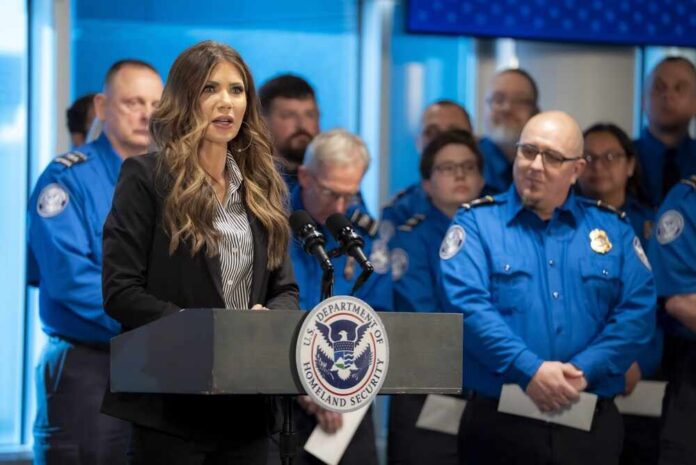
A later scenario put Noem in a national spotlight again, this time tied to constitutional norms rather than state politics. In a Senate Judiciary setting, lawmakers cited reports that ICE repeatedly violated federal court orders in detention and habeas-related matters. Federal judges in Minnesota and New Jersey were cited as documenting unusually high numbers of violations and admissions. Noem acknowledged agencies must follow court orders but then narrowed her answer with qualifiers about applicability and jurisdiction, and later declined to address specifics.
The constitutional concern here is not partisan theater; it is the basic separation of powers. When executive agencies treat federal court orders as optional, the precedent threatens every American who may need a judge to restrain government power—especially in detention cases where habeas corpus exists for a reason. It is competence and rule-of-law test under sustained questioning. On the facts provided, the political lesson is simple: conservative governance requires executive discipline under law, not improvisation.
Sources:
https://theweek.com/politics/noem-south-dakota-tribes-native-banish-territory