Iran’s president says the regime won’t “bow,” even as Operation Epic Fury exposes just how hard reality can hit a government built on threats, missiles, and propaganda.
Story Snapshot
- Operation Epic Fury began February 28, 2026 with nearly 900 coordinated U.S.-Israeli strikes in about 12 hours, followed by Iranian retaliation across the region.
- Iran’s leadership is under historic strain after Supreme Leader Ali Khamenei was killed and an Interim Leadership Council was announced March 1.
- President Masoud Pezeshkian’s defiant messaging is paired with signs of internal friction, including reports the Revolutionary Guards continued attacks despite his order to stop.
- More than 1,000 people are reported dead, with major damage to Iranian military, nuclear, and civilian infrastructure and ongoing risks to Gulf states and oil routes.
Operation Epic Fury: A Rapid Strike Campaign with a Clear U.S. Objective
U.S. and Israeli forces opened Operation Epic Fury on February 28, unleashing a wave of strikes described as nearly 900 attacks within a half-day. Iran responded with missile and drone launches across the Middle East between February 28 and March 1, expanding the fight beyond Iran’s borders. President Trump has publicly described the purpose as regime change and paired that with a four-week operational timeline—an objective, not an outcome—while the air campaign continues into its second week.
Developments since March 3 underscore the intensity and scope of targets. Reports describe strikes hitting Iran’s Supreme National Security Council headquarters, the Expediency Discernment Council building, an underground nuclear facility at Min Zadai, and damage at Bushehr Airport. On March 7, additional strikes were reported on Tehran and Isfahan infrastructure, while the U.S. approved a $151 million arms sale to Israel and deployed a third aircraft carrier, the USS George H. W. Bush.
“Won’t Bow Easily”: Iran’s Messaging vs. Its Leadership Vacuum
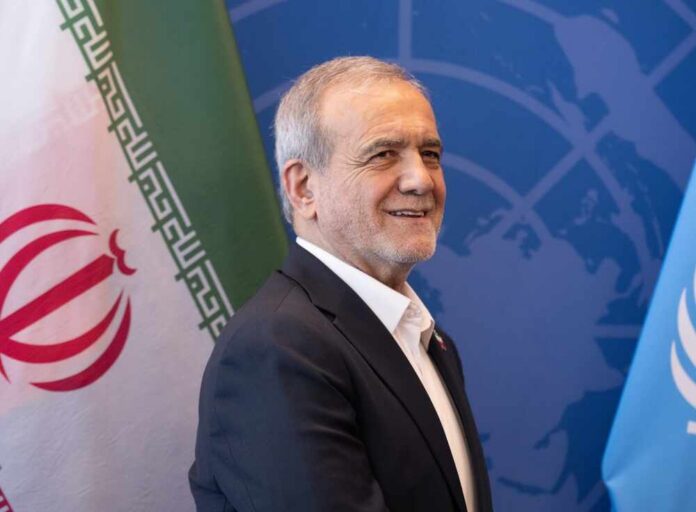
Iranian President Masoud Pezeshkian’s line that Iran will not “bow easily” is aimed at projecting continuity while the regime absorbs unprecedented blows. Supreme Leader Ali Khamenei was killed, triggering a governance crisis and the creation of an Interim Leadership Council announced March 1. That kind of rupture matters because Iran’s system is built around centralized religious authority, and replacing it quickly on paper does not guarantee real command over the security apparatus.
Signals of internal disagreement appear alongside the public defiance. Pezeshkian apologized to neighboring Gulf states for Iranian strikes and ordered armed forces to cease attacks, but those orders were “partially ignored.” The Revolutionary Guards reportedly continued operations anyway, pointing to a civil-military rift at the exact moment Iran needs unity. For Americans watching from home, it is a reminder that regimes often talk toughest when they are trying to mask instability and competing power centers.
Regional Blowback: Iran’s Strikes Risked Unifying Its Neighbors Against It
Iran’s retaliation has reportedly hit or threatened multiple regional states and facilities, pulling Gulf partners into the front of the crisis. The strikes across the UAE, Saudi Arabia, Qatar, Kuwait, Bahrain, Iraq, Oman, and Jordan, plus incidents in Basra involving Halliburton compounds. Former CIA Director David Petraeus is cited assessing that targeting Gulf states was likely a strategic error because it could widen the coalition against Iran rather than isolate Israel or pressure Washington into restraint.
A Reuters analysis makes the same basic point: once Iran’s missiles land near Gulf capitals and business centers, those governments tend to view Tehran as a direct threat. That raises the odds of deeper cooperation with U.S. and Israeli operations and less appetite for mediating Iran’s preferred off-ramps. Strategically, Iran can still cause damage, but diplomatically it may be shrinking its room to maneuver by threatening countries that control airspace, bases, and logistics routes central to U.S. power projection.
Human Costs, Unanswered Questions, and the Energy Chokepoint Risk
The war is already producing severe humanitarian fallout. More than 1,000 deaths and describes “hundreds of thousands” of travelers stranded. One of the most alarming reports is a strike on a girls’ school in Minab that killed at least 160 people; also notes responsibility remains unclear because Israeli officials denied involvement and the U.S. said it would investigate whether U.S. forces were involved. That uncertainty matters because civilian harm can fuel escalation and propaganda.
Energy security is another flashpoint conservatives will watch closely, especially after years of inflation pressure and policy-driven instability. It describes attacks on oil infrastructure in or near the Strait of Hormuz, a vital transit route for a large share of global oil shipments. Continued strikes, airspace closures, and shipping disruptions could ripple into prices for American families and small businesses. The Institute for the Study of War assessment cited adds that U.S.-Israeli forces are still degrading Iranian air defenses to maintain air superiority, signaling the campaign remains active.
Sources:
https://news.un.org/en/story/2026/03/1167065
https://understandingwar.org/research/middle-east/iran-update-evening-special-report-march-2-2026/