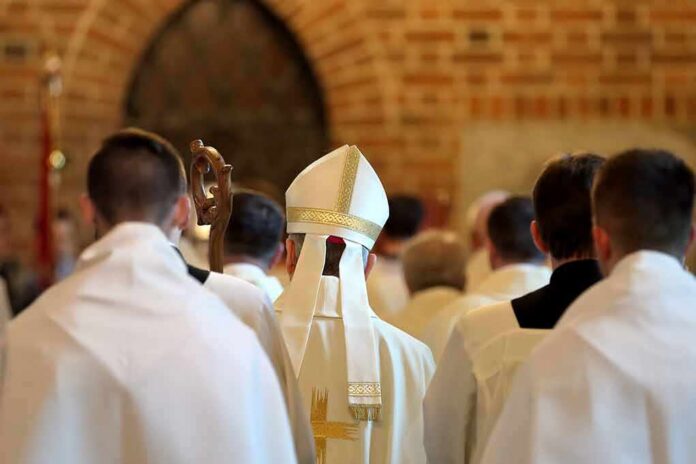
More than one in five U.S. Catholic bishops now say they are comfortable ordaining men with deep-seated same-sex attraction if those men promise celibacy, raising sharp questions about fidelity to church teaching and the future of the priesthood.
Story Snapshot
- About 22% of U.S. bishops support ordaining men with deep-seated same-sex attraction who pledge celibacy.
- Nearly half of bishops call a candidate’s dominant same-sex attraction “worrisome but not disqualifying,” showing a split in leadership.
- Vatican rules say men with “deep‑seated homosexual tendencies” should not be admitted to seminary or ordained.
- Progressive voices like Father James Martin hail this shift, while many Catholics see a serious moral and doctrinal crisis.
Survey Shows Significant Minority of Bishops Back Ordaining Gay Candidates
A new report based on research from the University of Notre Dame and the Center for Applied Research in the Apostolate found that about 22% of American bishops say they are “comfortable ordaining a man who experiences deep-seated same-sex attraction, provided he is firmly committed to celibacy.” This is not a tiny fringe. It means more than one in five of the men who oversee dioceses are open to ordaining candidates whose main sexual attraction is to other men, so long as those candidates promise to live without sexual activity.
The same research also asked bishops how a candidate’s dominant attraction to the same sex would affect their judgment. Almost half of the bishops, 48%, said that such attraction would be “worrisome, but not by itself disqualifying,” while 45% said it would be disqualifying on its own. That near-even split shows a deep divide inside the episcopacy on a sensitive question: whether stable same-sex attraction is itself enough reason to block a man from becoming a priest, even if he claims he will live a celibate life.
Church Teaching on Homosexual Tendencies and the Priesthood
Official Catholic teaching draws a clear line between same-sex attraction and same-sex acts. The Catechism describes homosexual acts as “intrinsically immoral” and contrary to natural law while calling homosexual tendencies “objectively disordered.” At the same time, the Church says that simply having such an attraction is not, by itself, a sin if a person lives chastely. That distinction has long shaped pastoral care, but it becomes sharper when the question shifts from ordinary parish life to the suitability of a man to be a priest.
In 2005, a Vatican document approved by Pope Benedict XVI stated that the Church “cannot admit to the seminary or to holy orders those who practice homosexuality, present deep-seated homosexual tendencies or support the so-called ‘gay culture.’” Later summaries of that teaching stress that such tendencies “gravely hinder” a candidate from relating correctly to men and women in ministry. In simple terms, Rome’s rule says that a man whose homosexual inclination is deep-rooted should not even begin priestly training, much less be ordained, because the risk to his spiritual life and to the flock is too great.
Bishops’ Mixed Interpretations and Progressive Celebration
The Notre Dame and CARA report suggests that bishops do not agree on what “deep-seated” means in practice. Some appear to interpret the term to focus mainly on behavior, arguing that a man can be ordained if he has same-sex attraction but shows he can live celibately. Others see “deep-seated” as describing a candidate whose sexual identity has become central to his life or who embraces modern “gay culture,” and they treat that as a clear block to seminary and ordination. A third group takes the Vatican rule at face value and simply says that if a man is gay, he cannot be admitted to formation or ordained at all.
Progressive Catholic outlets tied to Father James Martin, a Jesuit priest known for his outreach to LGBTQ-identifying Catholics, have highlighted the survey as good news. These voices frame the 22% figure as evidence of a growing “pastoral” openness among bishops toward gay men who seek the priesthood, and they link it to a broader trend in which priests who approve of Pope Francis are more likely to oppose blanket bans on gay priests. For many conservative Catholics, this looks less like mercy and more like a quiet attempt to bend discipline and blur doctrine under the banner of inclusion.
Wider Religious Landscape and Risks of Doctrinal Drift
Other Christian bodies offer a warning sign about where this kind of shift can lead. Mainline Protestant denominations such as the Episcopal Church, the Evangelical Lutheran Church in America, and the Presbyterian Church (U.S.A.) now allow openly gay or transgender clergy and conduct same-sex weddings in church. In the Episcopal Church, same-sex marriage rites became fully approved in 2015, and canon law explicitly protects access to ministry based on sexual orientation and gender identity. These moves were sold as compassionate steps, but they coincided with steep membership declines and ongoing battles over basic Christian moral teaching.
It would be interesting to know their reasons for supporting this highly controversial subject.
22% of US bishops favor ordination of men with deep-seated same-sex attraction, survey finds | News Headlines https://t.co/En7djKqkjF
— Dino Q. (@Chef242Don) July 25, 2026
For many faithful Catholics and constitutional conservatives, the new bishop survey looks like part of the same pattern of institutional drift. The Catholic Church claims to teach timeless truths about human nature and sexuality, not follow culture trends. When more than one in five U.S. bishops publicly say they are comfortable ordaining men whose primary sexual attraction runs directly against those teachings, even under a promise of celibacy, many laypeople see a moral crisis inside the hierarchy, not a minor policy tweak. They worry that if leaders cannot hold the line clearly inside the Church, it becomes harder for believers to defend natural law, family values, and basic moral sanity in the wider public square.
Sources:
lifesitenews.com, catholicculture.org, newwaysministry.org, outreach.faith, en.wikipedia.org, theguardian.com, prri.org, news.gallup.com