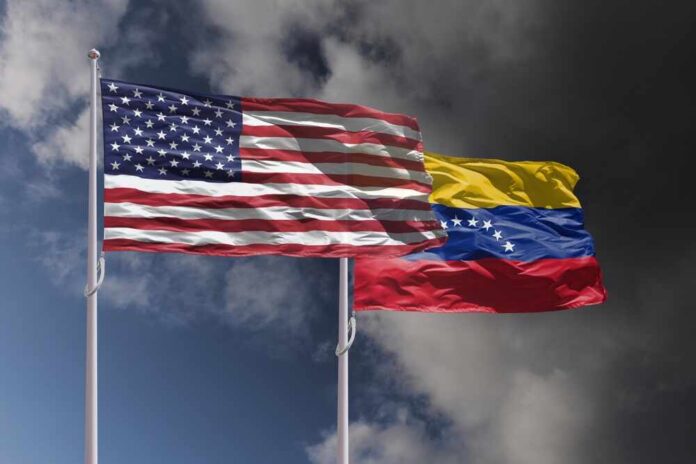
After seven years of diplomatic freeze, Washington’s reopening of ties with Caracas is back on the table—along with big questions about sovereignty, oil leverage, and what “transition” really means.
Story Snapshot
- The U.S. and Venezuela agreed March 5–6, 2026, to restore full diplomatic and consular relations for the first time since the 2019 rupture.
- The State Department framed the move around stability, economic recovery, and a phased transition to a democratically elected Venezuelan government.
- Embassy logistics appear to be moving, including reported delivery of equipment to the U.S. embassy in Caracas.
- Key disputed context remains: Venezuelan-aligned reporting describes January 2026 U.S. strikes and the kidnapping of Nicolás Maduro—details not mirrored in the State Department-focused account.
Diplomatic Relations Reopen After a 2019 Break
U.S. and Venezuelan interim authorities announced an agreement in early March 2026 to restore full diplomatic and consular relations, the first such normalization since ties were severed in 2019. The break began after Washington recognized opposition leader Juan Guaidó as interim president, prompting the Maduro government to cut relations. The new agreement signals a major policy shift, with both sides preparing for official engagement and consular operations again.
The State Department’s stated rationale centers on regional stability, economic recovery, and “political reconciliation,” paired with a phased political transition toward a democratically elected government. That framing matters because it suggests U.S. policy is not simply about reopening embassies; it is about shaping Venezuela’s internal political trajectory. For Americans wary of globalist “nation-building” language, the key issue is whether diplomatic normalization stays narrowly focused on citizens and security—or expands into open-ended political management.
What Happened in January 2026—and What Remains Unverified
The events that preceded the March agreement diverges sharply between sources. One account describes January 2026 as a dramatic escalation, including U.S. military strikes that killed more than 100 people and the kidnapping of President Nicolás Maduro and First Lady Cilia Flores. Venezuela condemned the action as a “criminal attack” while still launching a “diplomatic exploratory process” and later moving toward restored ties.
Other coverage anchored to the State Department announcement does not repeat those most explosive claims, which leaves readers with a practical problem: the core agreement is confirmed, but the most consequential alleged catalysts are not uniformly corroborated across the provided sources. There is no clear public accounting of Maduro’s status following the kidnapping claim. With limited cross-confirmation in the cited materials, a cautious takeaway is that the agreement is real, while some surrounding January details remain contested.
Embassy Reopening and Consular Services: The Practical Stakes
Beyond geopolitics, restored relations typically mean visas, travel documentation, and on-the-ground diplomatic channels. It indicates the U.S. had already sent a delegation to Caracas in January for technical assessments tied to reopening, and a cargo plane reportedly delivered equipment to the U.S. embassy in Caracas in the week before the March announcement. Those are concrete steps that point to implementation, not just symbolic statements from Washington and Caracas.
For American families and businesses, consular functionality is the measurable deliverable—help for citizens, lawful travel, and clearer communication during crises. For conservatives, the test is whether a reopened diplomatic footprint stays transparent and tightly mission-focused, rather than becoming another expensive foreign-policy project with fuzzy goals. It does not include staffing levels, budgets, or the exact timeline for full consular operations, leaving key operational details unanswered.
Oil, Sanctions Flexibility, and the Leverage Question
Energy and sanctions sit near the center of this story. The U.S. Treasury planned sanctions flexibilization related to Venezuelan oil transactions, alongside steps described as shielding funds from creditors. Separately, U.S. claims of control over PDVSA oil sales after the January escalation described in Venezuelan-aligned coverage. Even without every allegation fully matched across sources, the pattern is clear: normalization is intertwined with oil revenue access and controls.
That linkage creates a straightforward accountability question: if sanctions relief and oil arrangements are being adjusted, what explicit conditions apply, who verifies compliance, and how is money kept from strengthening entrenched political interests rather than helping ordinary Venezuelans? It points to goals like economic recovery and political transition, but it does not provide detailed enforcement mechanisms, metrics, or independent audits. In a post-inflation, post-overspending era, readers will want those specifics before accepting assurances.
Regional Players, Cuba, and the Limits of Diplomatic “Stability”
Regional mediation is also part of the backdrop. Brazil’s Lula da Silva, Spain’s José Luis Rodríguez Zapatero, and Qatar as mediators connected to detainee releases framed as a peace gesture. It also highlights Venezuela’s insistence on its historic relationship with Cuba and notes U.S. pressure that could complicate Cuban access to Venezuelan oil. This underscores how quickly a “bilateral” reset can spill into wider regional bargaining and influence campaigns.
I would never do business with the United States, and I'd live here.https://t.co/Ao8H2nUZS0
— Lilyjay000 (@lilyjay0007323) March 6, 2026
The bottom line is that restored relations can reduce tensions and reopen basic diplomatic channels, but it still leaves gaps on enforcement, verification, and the true balance of power behind the transition language. The agreement’s success will ultimately be judged less by press statements and more by measurable outcomes: safer regional conditions, legitimate elections with clear benchmarks, and a U.S. posture that defends American interests without sliding into another sprawling foreign entanglement.
Sources:
EE.UU. y Venezuela acuerdan restablecer relaciones
Venezuela moves to reestablish US diplomatic ties, reaffirms historic Cuba relationship
Venezuela – United States Department of State