
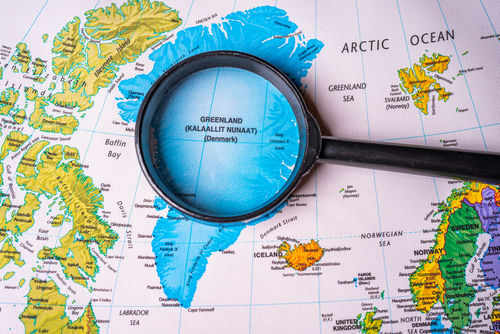
President Trump’s demand for complete control of Greenland—a territory belonging to NATO ally Denmark—has ignited what experts are calling the most dangerous crisis in the alliance’s 77-year history, with the President refusing to rule out military force to seize the Arctic territory.
Story Snapshot
- Trump demands “complete and total” acquisition of Greenland, refusing to rule out military force against NATO member Denmark
- Seven NATO countries deployed troops to Greenland; Trump retaliated with sweeping tariffs on eight alliance members
- NATO Secretary General describes situation as potentially the alliance’s “darkest hour” as foundational principles crumble
- U.S. already maintains military base in Greenland with unlimited troop deployment rights, making forced acquisition unnecessary
- Crisis exposes Trump’s failure to deliver on America First promises as administration purses costly territorial expansion over energy independence and peace
Trump’s Territorial Ambitions Threaten Alliance Stability
President Trump escalated his demands for Greenland in April 2026, sending a letter to Norwegian Prime Minister Jonas Gahr Støre declaring that global security is “impossible unless we have Complete and Total Control of Greenland.” The autonomous Danish territory sits at a strategic Arctic crossroads amid U.S.-China-Russia competition. Trump first floated the purchase idea during his first term but dismissed it as rhetorical posturing. His second-term approach represents a fundamental shift, backed by economic threats and refusal to exclude military options. The administration frames the demand as essential for national security, citing Chinese and Russian naval activity near Greenland and access to vast natural resources.
NATO Allies Push Back With Military and Economic Measures
Seven NATO countries deployed troops to Greenland specifically to send Trump a message that territorial aggression against a member state will not be tolerated. Trump responded by imposing sweeping tariffs on eight NATO countries, deepening the economic rift within the alliance. German Finance Minister Lars Klingbeil stated bluntly that “the limit has been reached” regarding Trump’s escalation. Danish Prime Minister Mette Frederiksen warned repeatedly that U.S. efforts to acquire Greenland could wreck NATO entirely. Denmark’s defense intelligence service took the unprecedented step of flagging the United States as a concern to Danish national security, marking a historic breakdown in transatlantic trust.
Unnecessary Confrontation Undermines American Security Interests
The United States already maintains a military base at Pituffik, Greenland, with Denmark’s permission to deploy unlimited numbers of troops without territorial acquisition. Security experts including Washington Post columnist David Ignatius warn that Trump’s “swaggering campaign” could damage American security for decades when existing arrangements already meet U.S. strategic needs. Greenland has explicitly stated openness to business partnerships with American companies while rejecting political acquisition. Former U.S. Ambassador to Russia Michael McFaul called Trump’s threats “the worst idea in American history,” noting the approach contradicts every principle of the post-World War II international order that secured American prosperity and prevented great-power conflicts.
Conservative Promises Abandoned for Globalist Power Plays
Trump campaigned on keeping America out of endless wars and prioritizing domestic concerns over foreign entanglements. His Greenland demands represent the opposite—a costly, aggressive territorial expansion that alienates allies while providing no tangible benefit to average Americans. The National Review editorial board, while sympathetic to Arctic security concerns, criticized the White House approach as “crass, clumsy and counterproductive,” noting that taking Greenland by force would be “ruinous militarily, economically and politically.” Many MAGA supporters who voted against regime-change wars and globalist agendas now question why the administration pursues confrontation with longtime allies instead of delivering lower energy costs and genuine peace promised during the campaign.
Alliance Fracture Empowers America’s Adversaries
NATO Secretary General Mark Rutte described the crisis as potentially NATO’s “darkest hour,” emphasizing that Trump’s threats violate the North Atlantic Treaty’s foundational principles of peaceful dispute resolution among members. Norwegian Foreign Minister Espen Barth Eide stated plainly that “the idea of NATO will be broken if the US takes Greenland,” warning that credible extended deterrence would cease to exist for Europe and Canada. If Trump follows through with military force against Denmark, Article 5 collective defense guarantees lose all credibility, effectively ending the alliance. Russia and China stand to gain enormously from NATO’s collapse, as European nations would lose access to critical American military capabilities while the U.S. would lose European bases essential for global operations, including recent strikes on Iranian nuclear facilities.
Constitutional Concerns and Executive Overreach Mount
Trump’s willingness to potentially use military force without Congressional authorization to seize territory from an ally raises serious constitutional questions about executive war powers. The administration’s State Department declared “This is OUR hemisphere” on social media, signaling a broad Monroe Doctrine expansion that already includes intervention in Venezuela and threats toward Cuba, Colombia, and Mexico. This approach to unilateral executive action in foreign policy mirrors the same government overreach that conservatives traditionally oppose in domestic contexts. Former Danish Minister Tom Hoyem called the threat “outrageous” and described it as “the toughest, deepest crisis NATO has ever had,” reflecting European shock that an American president would threaten military action against democratic allies while Constitutional constraints appear increasingly irrelevant to administration decision-making.
Sources:
The Week: Trump’s Greenland Demand Sparks NATO Crisis
Atlantic Council: Trump’s Quest for Greenland Could Be NATO’s Darkest Hour
Ara.cat: Trump’s Threat in Greenland Shakes NATO