
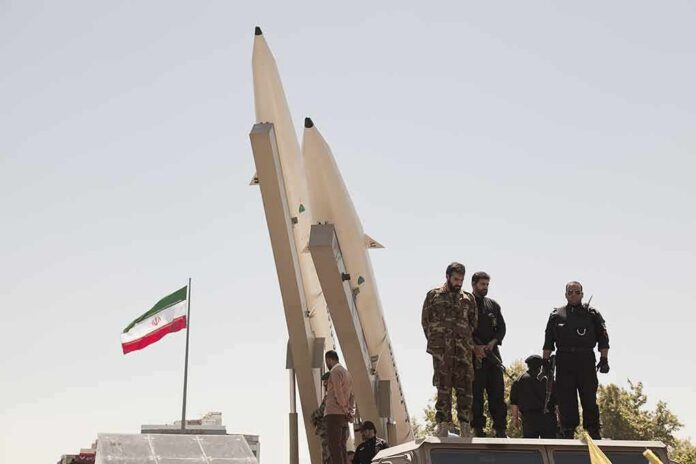
Israeli officials say Iran is rebuilding a large ballistic-missile stockpile, raising the risk to Israel and vital Gulf energy hubs if fighting resumes.
Story Highlights
- Israeli officials report Iran has rebuilt and is expanding parts of its missile arsenal.
- Analysts warn Iranian missiles and drones could threaten Gulf energy facilities.
- Reports cite possible production rates that could restore large capacity by 2027–2028.
- Iranian figures frame attacks on U.S.-linked assets as conditional but name sensitive targets.
Israeli Assessment: Iran Restoring Missile Capacity
Israeli security officials told reporters that Iran has rebuilt a significant portion of its ballistic-missile stockpile and is working to expand it. The officials linked the activity to preparation for possible renewed fighting, while saying it also serves Iran’s deterrence and bargaining aims if talks fail. Ground summaries of Israeli estimates say Iran may still have up to 2,000 ballistic missiles that can reach Israel, even after losses earlier in the conflict. These claims rely on unnamed officials and are not independently verified.
Reports describe wide ranges in Iran’s missile numbers, reflecting the fog of recent war and the lack of a public inventory. One report placed Iran near 1,300 missiles in mid-2025, another cited about 2,500 by early 2026, and later estimates pointed to as many as 2,000 remaining. These figures do not reconcile launches, destroyed systems, production, or readiness, so they should be treated as approximate signals rather than a firm count. Even with that caution, the trajectory points to renewed capacity.
Exercises and Production: Capability Signals Without Certainty
Strategic analysis noted that Iranian state-linked media reported the Islamic Revolutionary Guard Corps launched 30 ballistic missiles, including higher-end Khorramshahr and Emad systems, during large-scale drills. These events show parts of the force are active, but they do not prove how large or ready the full arsenal is today. Separate reporting suggested production rates in the range of 100 to 300 missiles per month could rebuild stocks to 2025 levels by early to mid-2027 and pose a major threat by 2028 if sustained. These timelines depend on continuous output.
Energy security experts warn that Iran’s mix of missiles, drones, sabotage, and cyberattacks could strike critical Gulf infrastructure. Separation facilities, pumping stations, offshore terminals, and chokepoints are vulnerable nodes. Even a few well-placed hits could shock energy markets, disrupt shipping, and raise prices at American pumps. This risk matters for U.S. families and industry because higher fuel costs ripple into groceries, shipping, and home heating. The analysis flags credible pathways to harm without claiming an imminent attack order.
Iran’s Public Messaging: Conditional Threats, Specific Targets
Senior Iranian figure Mohsen Rezaei said Iran has not chosen to strike U.S.-linked technology assets now, but warned those sites would be hit if Washington attacks again or war breaks out. He named undersea communications cables, data centers, and artificial-intelligence facilities in and around the Strait of Hormuz as potential targets and put their value above two trillion dollars. Iranian hardliners publicly backed this warning as a retaliatory option, making the threat more concrete even if conditional.
This posture underscores a key split between capability and intent. The public record supports growing capability and naming of sensitive targets. It does not prove an order to attack today. For U.S. readers, that still means risk. A single strike on energy nodes or digital lifelines could raise costs at home and test American resolve abroad. Clear-eyed planning, energy independence, strong deterrence, and tight sanctions enforcement fit the moment. Precision beats escalation; facts must guide choices.
What Washington Should Watch Now
U.S. and allied leaders should seek hard indicators that move beyond press leaks. Declassified inventories, commercial satellite images of factories and bunkers, and observed launcher movements would narrow the guesswork. Verification of missile test telemetry would show actual accuracy and range claims. Tracking shipping, cyber probing, and drone dispersal near energy sites would reveal intent shifts. Until then, Americans should expect market jitters and louder signaling from both sides, because energy and security stakes are high.
Sources:
zerohedge.com, cmsapi.theepochtimes.com, hudson.org, independent.co.uk, fr.jpost.com, csis.org