
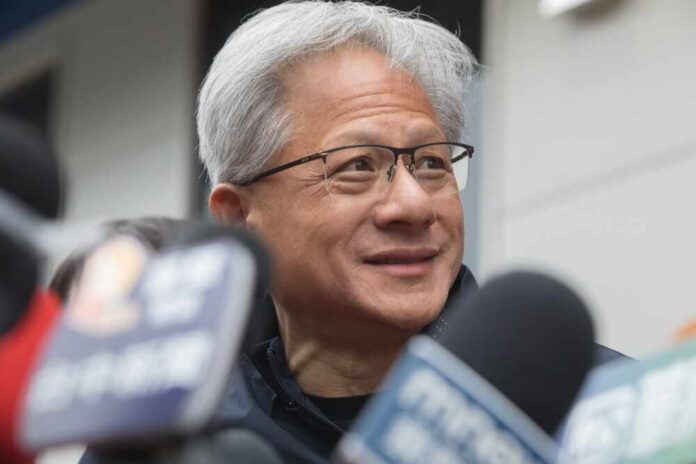
Nvidia’s Jensen Huang is pushing Trump to loosen tough AI chip limits on China, and that has big stakes for America’s security and wallet.
Story Snapshot
- Nvidia CEO Jensen Huang tells President Trump export curbs on AI chips “failed” and boosted China instead.
- Trump has rolled back some Biden-era chip restrictions while adding tariffs and revenue-sharing on exports.
- Conservatives in Congress warn loosening controls could arm China’s military and gut America’s AI edge.
- Huang backs “some” controls but wants to stop degrading chips for China and expand global AI sales.
Huang, Trump, And The New AI Chip Fight With China
Nvidia chief executive Jensen Huang has become a central voice in the fight over how far the United States should go in limiting advanced artificial intelligence chip sales to China. He has met with President Donald Trump and top Republicans to argue that past export controls under President Joe Biden “failed” because they pushed China to build its own chips faster and cost Nvidia billions in lost sales and write-offs.[8] Huang’s message is clear: America should sell more powerful chips abroad, not less.
President Trump has started to move away from the Biden approach of blanket restrictions. His administration approved sales of Nvidia’s H200 chips to “approved customers” in China, with the United States government taking a cut of the revenue, and separately allowed Nvidia and Advanced Micro Devices to resume some advanced exports while claiming a share of sales.[1][2] At the same time, Trump has kept tariffs and formal export licensing rules in place, promising taxpayers a direct benefit from every chip shipped into the Chinese market.[1][4]
National Security Hawks Push Back On Looser Rules
Conservative lawmakers and many national security experts warn that relaxing chip rules too far risks arming the Chinese Communist Party with the computing power it needs for advanced weapons, hacking, and mass surveillance. Representative Jim Banks called top American AI chips “the crown jewels of American power” and said strong export controls are needed to stop smuggling networks from feeding the Chinese military through third countries.[2] Policy analysts note that Washington has used export controls for years to choke off China’s access to the most advanced chips and tools.[19]
Others argue that controls must be targeted but firm to protect both our troops and our tech lead. Research from security think tanks describes how the United States and a few democratic allies dominate the most advanced chipmaking steps and can use that leverage as a nonproliferation tool.[19] These experts say cutting-edge graphics chips and manufacturing gear are “dual use” items that can power family apps at home or next-generation missiles abroad, so treating them like regular consumer goods would be reckless. From this view, Trump’s newer revenue-sharing export deals are only safe if tight guardrails and strong enforcement stay in place.[4][20]
Do Export Controls Backfire Or Buy Time For America?
Huang and some analysts claim that broad restrictions backfired by “galvanizing” Beijing to pour more money into its domestic chip sector, speeding up the very competitors Washington fears most.[6][8] They point to companies like Huawei, which pushed harder into homegrown hardware after being hit by earlier Trump and Biden sanctions, as proof that China will not sit still when cut off from U.S. parts.[18] In this telling, America risks losing sales, influence, and visibility into Chinese systems while helping its rivals learn to live without us.
National security voices see a different story. They argue that even if China doubles down on domestic chips, tight controls still slow it down in the short term and keep the most powerful systems in American hands.[15][16] Detailed studies of the 2022 export rules show that they were designed to hit specific “choke points” in the chip supply chain and block advanced gear for facilities linked to Chinese military end use.[16][22] For conservatives focused on deterrence, that slowdown window is priceless time to strengthen U.S. manufacturing, rebuild supply chains at home, and ensure that our warfighters, not Beijing’s, get the best silicon first.
Trump’s Balancing Act: Revenue, Security, And Manufacturing
Trump’s second-term approach tries to split the difference between Silicon Valley’s hunger for global sales and Capitol Hill’s demand for toughness on China. By allowing exports of certain chips like Nvidia’s H200 while keeping even more advanced “Blackwell” products off the table, the White House aims to give U.S. firms access to China’s big market without giving away the very top tier of capability.[1] The administration has also tied chip exports to tariffs and revenue-sharing schemes that direct a slice of profits back to American taxpayers and, in theory, into domestic industry and defense.
At the same time, Nvidia’s CEO has publicly praised Trump’s push to onshore more manufacturing, even as he criticizes some specific export bans that caused huge inventory write-downs.[7][9] Huang says he “supports export controls” and wants American companies to have “the best and the most and first,” but he opposes rules that force them to sell weakened, “degraded” chips into China that buyers will simply reject.[2][4] That stance reflects a broader business view: keep some security lines, but do not let Washington micromanage technical designs in ways that cripple U.S. competitiveness in a global market.
What It Means For Conservative Voters
For Trump-supporting conservatives, the fight over AI chips is not a tech insider squabble; it is about whether America keeps its edge over a hostile communist regime while protecting jobs and retirement savings here at home. Looser export rules may boost short-term profits for Nvidia and others, but if they allow China’s military and state-backed firms to close the gap in AI, the long-term cost could be deadly. On the other hand, clumsy, one-size-fits-all bans risk driving business offshore and undermining the very companies we depend on to arm our troops and grow our economy.[6][18]
The core question is whether Trump’s evolving policy keeps faith with his promise to put America first. That means insisting that the most advanced chips stay under U.S. and allied control, demanding strict screening of foreign buyers, punishing smuggling networks, and using tariffs and revenue shares to rebuild manufacturing in American towns rather than Beijing’s backyard.[1][4][19] As Jensen Huang and the White House continue to shape AI rules, conservative voters will need to watch closely that national security, not corporate lobbying, remains the top priority.
Sources:
[1] YouTube – Nvidia’s Jensen Huang discusses AI policy, manufacturing and Trump …
[2] Web – Why exporting advanced chips to China endangers US AI leadership
[4] Web – How Chip Export Controls Might Factor Into the U.S.-China AI Safety …
[6] Web – Understanding U.S. Allies’ Current Legal Authority to Implement AI …
[7] Web – [PDF] CHIPS, CHINA AND CHOKE POINTS
[8] Web – The Shifting Politics of AI Chip Export Controls
[9] Web – Nvidia CEO Jensen Huang declines Warren request to testify at AI …
[15] Web – NVIDIA CEO Refuses to Testify at US Senate Hearing … – Instagram
[16] Web – Balancing the Ledger: Export Controls on U.S. Chip Technology to …
[18] Web – Explaining all the US semiconductor export controls — EA Forum
[19] Web – How Trump’s export curbs on semiconductors and equipment hurt …
[20] Web – U.S. Semiconductor Exports to China: Current Policies and Trends
[22] Web – [PDF] Change and Continuity in US Export Control Policy