
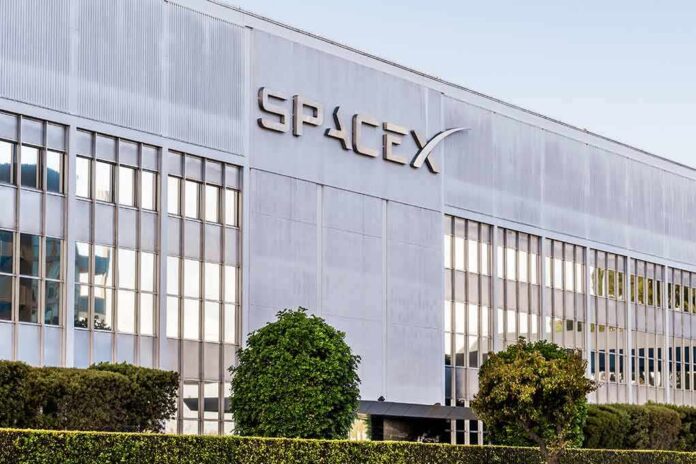
Federal regulators just cleared SpaceX to build up to one million orbital “data center” satellites, a first-of-its-kind green light with strict milestones and big implications for America’s tech edge and space rules.
Story Highlights
- The Federal Communications Commission authorized SpaceX’s Starmind network for up to one million satellites, with conditions.
- The order sets deployment milestones through 2040 and requires at least one operational space station by 2033.
- Reports say Starmind would link with Starlink using laser crosslinks to send results back to Earth.
- Scientists and rivals warn about debris, night-sky brightness, and economics at this scale.
What The FCC Approved And Why It Matters
The Federal Communications Commission (FCC) authorized SpaceX to operate up to one million satellites for a space-based computing constellation called Starmind. The order is a formal license, not just a concept nod, and establishes a path to deploy orbital compute modules that process data for use on Earth. The decision is historic because it sets the first ceiling at this size for data center satellites. It also tests how U.S. policy will balance innovation, spectrum use, and orbital safety at extreme scale.
The authorization includes firm timelines. SpaceX must place at least one authorized space station into operation by November 25, 2033. The milestones extend through 2040, giving time for manufacturing, launch, and operations to mature. Reporting describes these conditions as a framework to prove capability over time, not a blank check. Missing deadlines could void parts of the approval, underscoring that this is permission with strings attached, not a mandate to launch a million satellites.
How The System Would Work In Practice
Public reports say each Starmind unit would run compute in orbit, then move results to Earth through SpaceX’s existing Starlink network. Inter-satellite laser links would pass data across the constellation, easing reliance on ground stations. This design aims to shift power and cooling loads off Earth while using near-continuous sunlight in orbit. The FCC summarized the goal as processing large amounts of data for use on Earth, using abundant solar energy above the clouds.
The plan’s pace hinges on launch economics. Analysts and trade press tie deployment to SpaceX’s Starship rocket, which targets rapid reuse and lower costs. The FCC’s long runway to 2040 reflects that reality, allowing launch cadence and mass production to improve before scale-up. Still, the license does not prove one-million-unit feasibility. It sets an upper cap and conditions; SpaceX is not required to build the full fleet, and costs, power budgets, and spacecraft designs are still developing in public view.
Benefits, Risks, And The Politics Of The Night Sky
Supporters argue orbital compute could ease pressure on land, power grids, and water used by ground data centers. They point to uninterrupted sunlight in orbit and the ability to process sensitive workloads far from physical threats. Critics counter that environmental and astronomy impacts are not settled. Reports highlight concerns over brightness in the night sky, interference with telescopes, debris, and reentry pollution, with scientists urging deeper review before mass deployment proceeds.
BIG NEWS: SpaceX’s plan to build AI data centers in space with up to 1 MILLION satellites wins historic FCC approval. 🚀🇺🇸
• The Starmind constellation will harness solar energy to power advanced AI.
• Satellites will process massive amounts of data for use back on Earth.
•…
— Claire Hathaway (@ClaireHathway) November 27, 2026
Commercial rivals also weighed in during the proceeding. Companies with competing constellations raised interference and congestion concerns, positioning themselves against a project that could reshape market share. The FCC’s decision, while conditional, will be read as a signal that the United States under President Trump is open to bold space infrastructure if it follows rules and meets deadlines. That aligns with a pro-growth, pro-innovation stance, but it also puts oversight on the clock to keep orbits safe and skies usable.
What Comes Next For Conservatives To Watch
Key tests now move from policy to performance. First, can launch costs and cadence support even a fraction of this scale by 2040 without shifting risks to taxpayers or the environment? Second, will orbital safety measures keep pace to prevent collisions and protect critical satellites we all rely on? Third, can SpaceX prove real power and thermal solutions that make space compute efficient and reliable? Those answers will determine whether this license becomes a breakthrough or a ceiling.
Sources:
wsj.com, aviationweek.com, afp.com, wcvb.com, mashable.com, fcc.gov