When a public body opens with prayer, the law protects the practice only if access is evenhanded and the message remains the speaker’s, not the government’s; Bartow, Florida’s uproar over a Muslim imam’s invocation is a textbook test of whether communities understand that bargain — and whether they will honor it when the invited voice is not their own.
At a Glance
- Legislative prayer is constitutional when offered on a neutral, inclusive basis and without government editing of content, per Supreme Court precedent.
- Bartow invited a local imam to give an invocation after outreach tied to inclusion in the rotation; the agenda named him in advance, and he proceeded despite disruption from some attendees.
- Opponents objected on grounds of tradition and identity, reciting the Lord’s Prayer and chanting as protest; police escorted some out so the meeting could continue.
- The controlling legal rule is simple: if you keep prayer, you keep it open; if you want exclusivity, you forgo prayer entirely. Town of Greece v. Galloway makes that tradeoff explicit.
What happened in Bartow, and why the mechanism matters
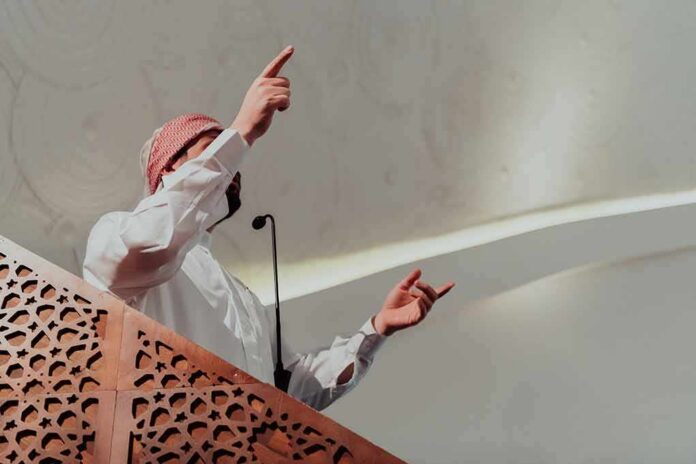
The mechanism is straightforward. Bartow’s meeting agenda listed Imam Sajid R. Bhuiya of the local Masjid Al Nur to deliver the invocation; city officials explained that the invitation flowed from inclusion-oriented outreach after a Hindu representative had initially sought a slot but could not attend on the date offered. The city attorney described that chain — contact from one non-Christian faith group, followed by outreach to another — as part of an open-door approach to invocations. Multiple outlets and the city’s own meeting video corroborate that the imam was scheduled, took the lectern, and, after extended disruption, completed a brief English invocation asking for wisdom.
The protest was organized around identity rather than process. A number of attendees stood, recited the Lord’s Prayer in unison, and shouted phrases such as “Jesus is King,” “We don’t pray to that god,” and “This is a Christian nation.” Police removed some individuals who ignored repeated requests to stop interrupting. The commission proceeded with its agenda. The incident was quickly framed online as either a defense of tradition or an affront to pluralism; the facts are more prosaic and more important: the city followed the established constitutional playbook for legislative prayer; a portion of the audience rejected the speaker.
The constitutional baseline: you can keep prayer, or you can keep exclusivity — not both
Two Supreme Court decisions set the ground rules. In Marsh v. Chambers (1983), the Court upheld opening prayers at a state legislature, pointing to the nation’s “unambiguous and unbroken history” of legislative invocations reaching back to the First Congress. That history took legislative prayer outside the usual Establishment Clause tests; the practice could stand, the Court said, so long as it was not exploited to proselytize or disparage.
Town of Greece v. Galloway (2014) applied and modernized that logic at the municipal level. The justices approved a town’s practice of inviting local clergy to offer sectarian prayers at board meetings, with two conditions that matter in Bartow: access must be non-discriminatory across faiths and beliefs, and the government may not supervise or sanitize content in ways that turn private prayer into the state’s message. In concrete terms, a city may allow explicitly Christian, Jewish, Muslim, Hindu, or humanist invocations selected through a neutral process; it may not limit the mic to a preferred creed or script the words to drain all religious specificity.
How Bartow’s approach fits the law
On the record available, Bartow’s choice tracks Town of Greece closely. The city attorney’s account describes a neutral, outward-facing process — an initial approach by a Hindu representative, scheduling friction, and then a referral to the local mosque — rather than a decision to privilege one religion. The imam’s appearance was published on the official agenda; he offered a short invocation rooted in his tradition, in English, aimed at the civic task at hand (wisdom for commissioners). That is precisely the sort of sectarian but civic-framed prayer Town of Greece allows.
By contrast, the objection that a “Christian city” should reserve the invocation for Christian prayer collides with the same precedent. Tradition matters under Marsh, but contemporary access matters under Town of Greece: once a government opens the forum, it must keep it open on equal terms. If a community is unwilling to hear from speakers of differing faiths, the constitutionally coherent remedy is to discontinue official invocations entirely, replacing them with a moment of silence or no opening observance — not to enforce a de facto religious test at a public microphone.
Where the genuine disagreement lies: tradition, identity, and the boundary between protest and disruption
America’s argument over legislative prayer is not about whether many citizens prefer prayers that mirror their own creed; of course they do. The disagreement is over what government may lawfully host and what a plural public forum requires. Those who disrupted Bartow’s meeting framed their response as fidelity to the community’s Christian heritage. The legal tradition they invoke, however, is precisely the tradition that protects a rotating speaker’s freedom to pray from his or her own tradition — and that bars the city from editing or excluding based on theology. That tension between cultural majority preference and constitutional neutrality is the fulcrum of nearly every modern invocation dispute.
Protest is protected; disruption of a public meeting is not. Citizens may object during public-comment periods, hold signs outside, or organize counter-invocations at lawful times and places. But drowning out the invited speaker at the gavel’s opening undermines the same free-exercise and free-speech principles that keep the door open for everyone. Police removals in such moments enforce viewpoint-neutral rules of order — time, place, and manner — not theology. Cities that want to preserve both order and openness codify those rules in advance and apply them evenly.
In Bartow, Florida, a Muslim invocation speaker at a city council meeting was *repeatedly* interrupted by Christian zealots who screamed out the Lord's Prayer.
One deranged activist later told the council, "These people do not belong here." pic.twitter.com/JySWZWCW4c
— Hemant Mehta (@hemantmehta) November 19, 2026
Implications for cities: design the policy you can defend — and live with
For governing bodies, the lesson is plain. First, adopt a written invocation policy anchored in the Town of Greece framework: define the forum (brief opening remarks for solemnization), specify a neutral selection method (e.g., invitations to all known congregations and belief groups within a geographic catchment or a first-come, first-served speaker registry), and disclaim government control over content beyond a narrow bar on proselytizing, disparagement, or coercion. Second, publish schedules early and consistently, so inclusion is transparent rather than episodic. Third, separate the invocation from public comment procedurally, and train the chair and sergeant-at-arms on viewpoint-neutral enforcement of decorum rules. These steps are not performative; they are what make the practice legally and practically sustainable.
If the community wants a single-faith prayer, the constitutional path is to forgo official prayer
Some communities will decide that the friction of plural access is not worth it. That is a respectable choice — and likely the only lawful way to preserve a uniform religious expression at the start of civic business. Replace the invocation with a moment of silence or begin meetings directly with the pledge. What the law does not permit is the middle path some demanded in Bartow: an official prayer offered only by members of the majority faith while excluding others. The Supreme Court has already drawn that line, and cities ignore it at their peril.
Sources:
thegatewaypundit.com, wtsp.com, wfla.com, mycharisma.com, pembrokepinesflnews.com