
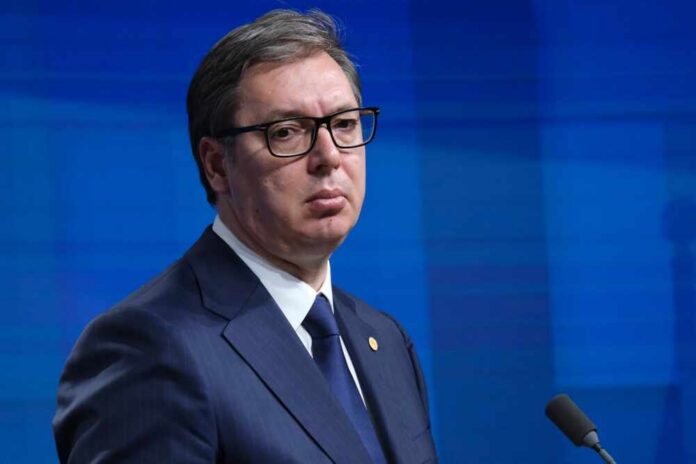
Serbian President Aleksandar Vučić publicly rebuked Hungary’s incoming Prime Minister Péter Magyar after the newly elected leader accused Russia’s Vladimir Putin of acting as a puppet master orchestrating political alliances in Serbia, a claim that underscores deepening rifts in Central Europe as traditional power structures crumble.
Story Snapshot
- Péter Magyar claimed Putin “pulls the strings” in Serbia and alleged the Russian leader is the “godfather” behind Vučić’s ties to former Hungarian PM Viktor Orbán and Slovak PM Robert Fico
- Vučić denounced Magyar’s remarks as “stupid” and “irresponsible,” challenging him to name Putin directly while defending Serbia’s sovereignty
- The clash follows Magyar’s landslide election victory ending Orbán’s 16-year rule and comes amid suspicions over explosives found near a critical Russian gas pipeline
- Both leaders pledged to maintain bilateral relations despite the sharp public disagreement, revealing the fragile balance between political posturing and economic pragmatism
New Hungarian Leader Challenges Serbia’s Russian Ties
Péter Magyar wasted no time stirring controversy after his Tisza Party’s landslide victory on April 12, 2026, ended Viktor Orbán’s grip on Hungary. During an international press conference the following day, Magyar accused Orbán’s government of cultivating entanglements with Serbia and Slovakia, suggesting Putin served as the unseen orchestrator. Magyar went further, labeling the April 5 discovery of explosives near the TurkStream gas pipeline close to the Hungarian border a potential false-flag operation designed to serve political ends. These allegations mark a dramatic departure from Hungary’s recent pro-Russian alignment under Orbán.
Magyar’s comments signal an emerging shift in Central European politics, where leaders who once cooperated with Moscow now face scrutiny from reformist successors. His willingness to publicly question Serbia’s relationship with Russia reflects broader frustrations among voters tired of backroom deals and opaque alliances. For many citizens across the region who feel betrayed by elites prioritizing geopolitical maneuvering over national interests, Magyar’s rhetoric resonates as a challenge to business-as-usual governance.
Vučić Fires Back, Defends Sovereignty
Vučić responded swiftly during a Monday evening interview on Serbian state television, dismissing Magyar’s assertions as baseless and reckless. He challenged the Hungarian leader to explicitly name Putin if he had evidence, calling the insinuations foolish and irresponsible. Vučić framed the remarks as an attack on Serbia’s sovereignty and pledged to share the results of the ongoing pipeline investigation with Magyar, expressing confidence the findings would debunk false-flag theories. Despite the sharp tone, Vučić emphasized his desire to preserve good relations with Hungary, a neighbor with significant economic and energy ties.
The Serbian president’s defensive posture reveals the tightrope he walks between maintaining partnerships with Russia and pursuing EU accession. For conservatives wary of globalist agendas and liberal internationalism, Vučić’s stance reflects a leader protecting national interests against external pressure. Yet his reluctance to directly address Putin’s role raises questions about the depth of Serbia’s dependence on Moscow, particularly regarding energy security through the TurkStream pipeline that supplies Russian gas to Hungary via Serbian territory. This dependency complicates any claims of full autonomy.
Pipeline Incident Fuels Suspicions and Geopolitical Tensions
The discovery of explosives near the TurkStream pipeline on April 5 provided Magyar with ammunition for his campaign narrative, framing the incident as emblematic of the shadowy dealings he promised to investigate. TurkStream represents a critical artery for Hungary’s gas supply, making any threat to its security a matter of national concern. Magyar’s suggestion that the explosives may have been planted to manipulate public opinion taps into widespread skepticism about government transparency, a sentiment shared by citizens on both the left and right who increasingly view official narratives with distrust.
Serbia’s Vučić Slams New Hungarian PM Magyar for Claiming Russia’s Putin ‘Pulls the Strings’ in His Country
READ: https://t.co/QYUNCnO9Ed pic.twitter.com/JK2UznyqxY
— The Gateway Pundit (@gatewaypundit) April 15, 2026
Vučić’s promise to deliver investigation findings to Magyar sets the stage for a potential credibility test. If the results contradict Magyar’s false-flag theory, the Hungarian leader risks appearing reckless; if they validate suspicions, Vučić faces intensified pressure over Russian influence. This clash illustrates how energy infrastructure has become a flashpoint in regional power struggles, with ordinary citizens vulnerable to disruptions while leaders trade accusations. The outcome may determine whether Central Europe continues drifting toward Moscow or pivots back toward Brussels, a decision with profound implications for sovereignty and economic stability.
Sources:
Serbia’s Vučić clashes with Péter Magyar over Putin ‘godfather’ remark – Euronews
Putin terheq fijet edhe në Serbi, Vuçiç përplaset me kryeministrin e r – VoxNews.al