
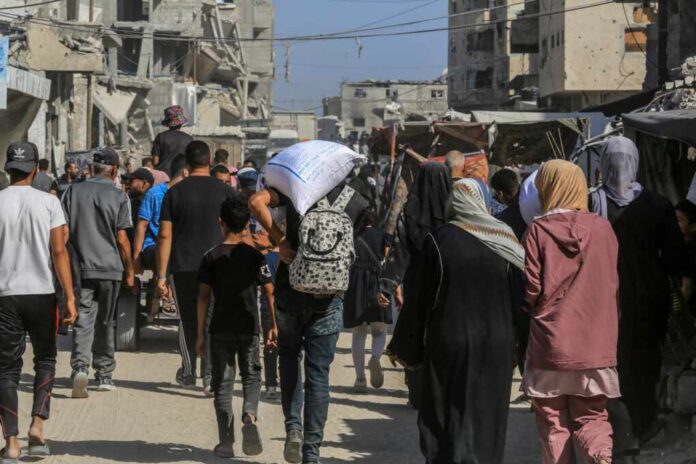
A United Nations agency is now blaming the Iran war—and by extension American energy costs—for a looming hunger crisis, even as its own data shows a far more complex picture.
Story Snapshot
- The United Nations World Food Programme warns the Middle East war “could” push up to 45 million more people into acute hunger if high oil prices persist.
- Rising fuel, shipping, and fertilizer costs tied to conflict around Iran are straining humanitarian supply chains and import‑dependent poor countries.[2]
- The warning is a conditional projection, not a measured fact, and sits on top of an already severe global hunger crisis of 318 million people.
- Multiple overlapping causes—local conflict, debt, inflation, and weak governance—are also driving hunger, raising questions about one‑war political narratives.[2]
UN Food Agency Ties Iran War to a Potential Global Hunger Surge
The United Nations World Food Programme (WFP) is warning that the current Middle East war, sparked by Israeli and United States strikes on Iran and followed by Iranian and proxy attacks, could trigger the worst disruption to humanitarian work since the COVID pandemic and the Ukraine conflict.[2] WFP leaders say longer shipping times, higher freight rates, and more expensive fuel are hammering their ability to move food aid efficiently and cheaply to the world’s poorest communities.[2]
According to WFP Deputy Executive Director Carl Skau, shipping costs for the agency have already risen about 18 percent, while thousands of its trucks now operate on significantly more expensive fuel.[2] Every extra dollar spent on freight or diesel means fewer dollars available to purchase food or provide cash assistance, directly shrinking rations for vulnerable families.[2] WFP argues that if this pattern persists it will reduce both the volume and reach of life‑saving food distributions worldwide.[2]
How Conflict Around Iran Drives Prices, Fertilizer, and Food Insecurity
United Nations reporting links much of the risk to disruptions around the Strait of Hormuz, the narrow sea lane through which a major share of global oil and fertilizers move.[2][4] WFP notes that roughly a quarter of the world’s fertilizer supply typically transits that corridor, which officials now describe as operating at a “virtual standstill” because of military escalation.[2] If fertilizer shipments remain blocked or delayed going into key planting seasons, particularly in sub‑Saharan Africa, harvests could suffer and local food prices could spike sharply.[2][4]
Import‑dependent nations in sub‑Saharan Africa and Asia are especially exposed because they rely heavily on global markets for basic grains, fuel, and agricultural inputs.[2] When conflict pushes up energy prices, farmers face higher costs for fuel, irrigation, and transport, while humanitarian agencies pay more to move the same amount of food.[4] United Nations briefings and media analyses highlight that food prices were already elevated and fertilizer costs had “rocketed” before this latest escalation, making fragile economies extremely sensitive to additional shocks.[4]
From Projection to Politics: What the ‘45 Million’ Number Really Means
WFP’s headline estimate—that up to 45 million additional people could be pushed into acute hunger if the Middle East conflict continues through June and oil remains above $100 a barrel—is a scenario, not an observed reality.[2] Agency materials consistently use conditional language such as “could” and tie the figure to assumptions about conflict duration and sustained high prices, rather than current, measured increases in hunger outcomes.[2] The number is intended as an early warning about risk, not a final tally.
Geopolitics enters unhedged deadlock as Iran demands cash, Gulf fire erupts and Trump changes rhetoric.
• Trump pivot: after threats to seize Iran’s uranium, Trump now says he is open to meeting Mojtaba Khamenei face-to-face.
• US-Iran deadlock: Iran says the 60d MoU track is… https://t.co/CNjQGP0ZSU pic.twitter.com/q1hhsB1yhM
— CXL_LAB (@CXL_LAB) June 6, 2026
At the same time, WFP’s own framing stresses that global hunger is already being driven by several overlapping forces. The agency reports that around 318 million people were facing crisis levels of hunger or worse in 2026 even before the latest escalation, with nearly 70 percent living in countries already affected by conflict or fragility. Other wars in Africa, economic crises, local mismanagement, and previous price shocks all play major roles, complicating any attempt to pin the entire problem on one conflict.
What This Means for Americans, Taxpayers, and Conservative Priorities
United Nations agencies are now effectively warning that instability in and around Iran can reverberate directly into American pocketbooks by pushing global energy and food prices higher.[2][4] That message reinforces what many conservatives have long argued: when Washington is entangled in endless Middle East conflicts and global supply chains are vulnerable, working families everywhere pay the price through inflated grocery and fuel bills. Rising humanitarian needs also increase pressure for larger foreign‑aid budgets funded by American taxpayers.
At the same time, the data show that the world was already in a deep hunger crisis due to years of conflict, bad governance, and economic mismanagement in many regions before this war. For readers who value limited government, fiscal responsibility, and strong borders, the challenge is twofold. First, resist simplistic narratives that treat one war as the sole cause of global hunger when underlying structural failures and local corruption are central drivers. Second, demand transparency and hard numbers when international bodies use dramatic projections to call for more funding or policy concessions.
Sources:
[2] Web – Iran | World Food Programme
[4] Web – Middle East war risks pushing 45 million more people into acute …