
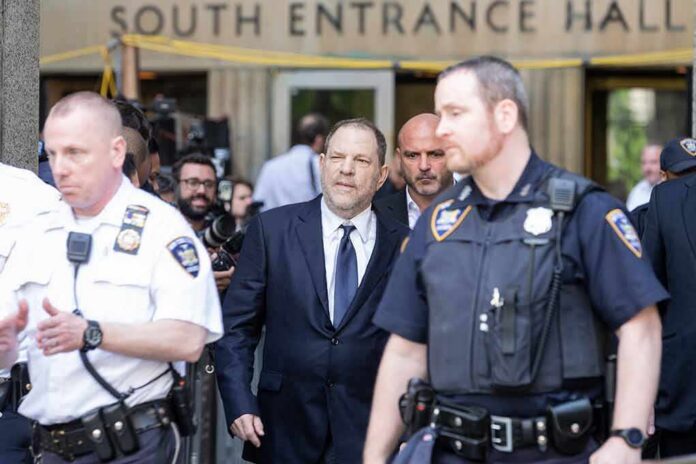
A New York judge sentenced Harvey Weinstein to 15 years after a retrial jury again found him guilty of a 2006 criminal sexual act against Miriam Haley.
Story Highlights
- A jury reconvicted Weinstein for a first-degree criminal sexual act against Miriam Haley.
- The judge imposed a 15-year prison sentence and cited Weinstein’s lack of remorse.
- Haley testified she said “no” and described forced oral sex in 2006.
- New York’s highest court overturned a 2020 verdict, but prosecutors won again on Haley’s count.
Jury Reconvicts After Appeals Reboot
New York jurors convicted Harvey Weinstein in June 2025 of first-degree criminal sexual act against former production assistant Miriam Haley after the state’s top court overturned parts of his 2020 case. Reporters covering the retrial said the panel weighed testimony focused on one incident from 2006. Prosecutors centered their case on Haley’s direct account and the power gap she faced. Coverage notes jurors still found guilt on Haley’s count after the appellate reset.
Reporting states the retrial produced a mixed but decisive outcome. Jurors convicted on Haley’s charge and did not adopt defense claims of consensual encounters for that count. Analysts cautioned that appeals often turn on rules, not facts, so the new verdict reflects fresh juror judgment under tighter evidence screens. That matters for public trust. It shows the case did not rest on a tainted framework but survived more scrutiny and still reached a guilty result.
Haley’s Testimony and the Court’s Findings
Associated Press and PBS reports detail Haley’s sworn account. She said Weinstein held her down and forced oral sex after she refused, telling him, “No, no — it’s not going to happen.” She said she met him for career reasons, not romance. Coverage said she had worked briefly on Project Runway and sought professional opportunity. Jurors heard this narrative directly, then returned a guilty verdict for the criminal sexual act count tied to her testimony.
At sentencing, outlets report the judge called Weinstein a sexual predator with no remorse and said he lured Haley with job promises. The court imposed a 15-year prison term. Haley delivered a victim-impact statement that described a long shadow on her life and said testifying twice felt like a “life sentence.” The judge’s words reflected the verdict and the harm described, while the sentence marked a substantial penalty for the 2006 offense.
Defense Denial, Public Accountability, and Legal Limits
Weinstein maintained his innocence throughout the retrial and sentencing. Reports quote him apologizing for pain but rejecting the assault claim. Defense lawyers argued that encounters were consensual or transactional with industry benefits. The jury did not accept that argument for Haley’s charge. Coverage also shows the court weighed his denial against the record and the lack of remorse it perceived, before setting the 15-year term.
Former film mogul Harvey Weinstein was sentenced to 15 years in prison for a 2006 sex crime in New York, capping a dramatic fall for one of Hollywood's most powerful producers. The sentence reflected court findings that Weinstein committed sexual assault in a case that sparked… pic.twitter.com/ply4VQP8wu
— Ocean News (@OceanNewsUK) September 24, 2026
This case highlights a basic principle conservatives value: due process with real consequences. New York’s highest court forced a do-over, and prosecutors re-tried the facts under tighter rules. A new jury again found guilt on Haley’s count. That is how the system should work. The process protected the accused, heard the victim, and reached a clear outcome. Appeals may follow, but the current record reflects a tested verdict, not a media script.
Why This Matters Beyond Hollywood
Powerful people often count on delay and legal fog to outlast victims. This retrial shows jurors can judge facts even years later. Legal scholars note sexual assault cases often hinge on credibility and may lack forensic proof. Courts allow testimony and careful instructions to guide jurors. Haley’s account, her purpose for meeting, and the jury’s assessment carried the day. The result signals that fame, wealth, and influence do not place anyone above the law.
Readers should separate feelings about Hollywood’s politics from the core facts here. The appellate court ruled on legal errors, not blanket innocence. Prosecutors then proved the criminal sexual act case again. The judge’s sentencing remarks tracked the verdict and the harm described. Weinstein’s denial remains on record, but the legal weight now rests on the jury’s finding and the court’s judgment. That is the standard for accountability, regardless of status.
Cultural Takeaway for Families and Communities
Parents teach their kids that “no” means “no,” and that work meetings should be safe. Haley said she sought career help and said “no.” The jury believed her. That message matters at home, at school, and at work. It also shows why clear rules, fair trials, and equal justice protect everyone. Politics shift, news cycles spin, but the law’s duty remains steady. When courts follow the rules and juries weigh facts, trust in our system can grow.
Sources:
youtube.com, apnews.com, abcnews.com, pbs.org, abc.net.au, people.com, reuters.com, bbc.com, mediaite.com, news.sky.com