UCLA’s Students for Justice in Palestine plans a noon Oct. 7 march marking the Hamas massacre’s anniversary, stoking fresh outrage and safety concerns on campus.
Story Highlights
- UCLA SJP scheduled an Oct. 7 march at Bruin Plaza to mark three years since the Hamas attack.
- Organizers frame the event as political speech tied to divestment and campus policy demands.
- Past Oct. 7 UCLA protests drew hundreds and remained largely contained to set areas.
- Public universities can enforce content-neutral time, place, and manner rules under the First Amendment.
What Organizers Announced For Oct. 7
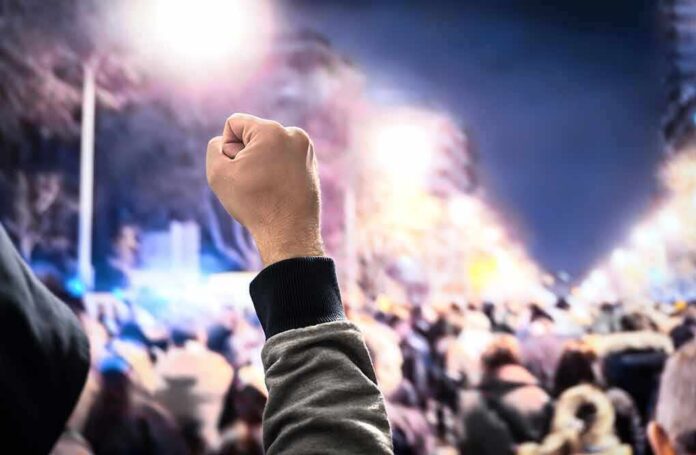
The student group Students for Justice in Palestine at the University of California, Los Angeles announced a large march set for noon on October 7 at Bruin Plaza. The group said the demonstration will mark three years since the Hamas attack in Israel. The release positioned the event as a campus-wide mobilization. The planned date and place put the march at the center of student life. That timing guarantees strong attention, and likely counter-protest activity, from across the community.
Students for Justice in Palestine leaders have linked similar actions to political goals on campus. Their past statements connected Oct. 7 events to calls for divestment from Israel-related holdings and changes to campus policing. They also pressed for severing academic ties to Israeli institutions and naming the war as a genocide. Their framing presents the march as civic speech and a demand for policy change, not as personal harassment of peers.
How Prior Oct. 7 Protests Unfolded At UCLA
Prior years show what to expect on the ground. In 2024, students gathered on North Campus for a march that grew to a few hundred by evening. The marchers chanted, carried signs, and drew a small group of counter-protesters who raised Israeli flags. The event moved near a museum hosting a related play. Police presence remained visible but measured, and the protest did not spiral into mass arrests per local reporting.
Reports also show the university steering demonstrations into designated free-speech areas. A Students for Justice in Palestine-led protest in Los Angeles strayed from, then returned to, those zones. The group repeated its demands: campus divestment, abolishing the campus police department, and cutting academic links to Israel. Administrators emphasized that the zones applied to all sides. That approach aimed to reduce clashes while allowing expression to continue.
What The Law Allows UCLA To Do
Public universities may apply content-neutral limits on protests to protect safety and learning. That includes setting reasonable time, place, and manner rules that do not target a viewpoint. Those rules can guide march routes, sound levels, and hours. They cannot punish speech because it is unpopular. Courts and policy groups have long recognized these limits as the right balance between order and free expression on campus.
Civil liberties research shows only a small share of campuses still rely on strict “free speech zones.” When used, they must be narrow and fair to pass legal muster. Policies that corral speech too much can invite abuse. On the other hand, clear, even-handed rules can help officials prevent blocked walkways, threats, or violence while keeping debate open. That balance will matter at UCLA on a day loaded with emotion and media attention.
Why The Date Magnifies Tensions
October 7 carries a heavy meaning because it marks the Hamas massacre and the start of the wider war. That symbolism draws larger crowds, sharper rhetoric, and stronger feelings. Los Angeles campuses saw this pattern before. Large turnouts, counter-protests, and close police monitoring have become common on that date. Even when events stay nonviolent, the symbolic weight raises the stakes for students, staff, and neighbors who worry about safety and respect on shared grounds.
For conservative readers, two principles should move in step here. First, the Constitution protects peaceful speech, even when it offends. Second, no student should face threats, blockades, or hostility that shuts them out of campus life. The First Amendment standard gives public schools tools to safeguard both. If UCLA enforces neutral rules for time, place, and manner, it can protect rights and keep order as this march unfolds.
Sources:
nypost.com, campus-speech.law.duke.edu, uclaradio.com, latimes.com, peoplesworld.org