
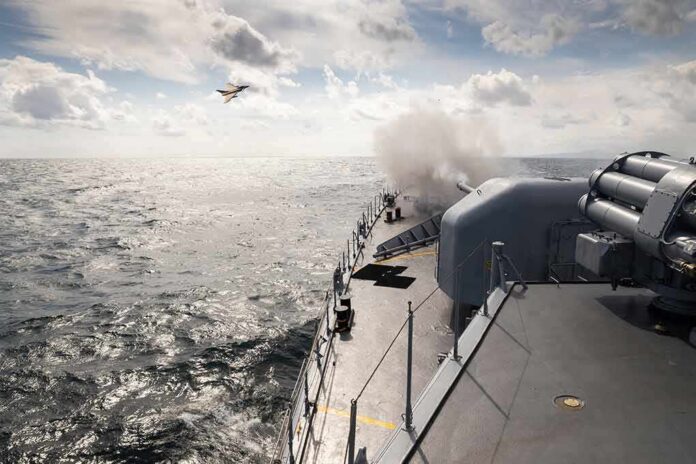
The U.S. Navy and Shield AI just committed $400 million to a vertical takeoff unmanned “fighter” that could fly by year’s end, aiming to boost American power from ship decks without runways.
Story Highlights
- The Navy executed a $150 million funding modification for X-BAT development.
- Total public-private investment tallies $400 million, combining government and company funds.
- Shield AI targets initial flight testing by the end of 2026 with full-scale prototypes.
- X-BAT is built for vertical takeoff and landing from ships and austere sites under RIMES.
Navy Backs Runway-Independent Combat Power With Major X-BAT Funding
Shield AI announced that the Navy executed a $150 million modification to an existing prototype agreement for X-BAT, the company’s vertical takeoff unmanned aircraft. Shield AI said the action is funded through the Office of the Under Secretary of War for Acquisition and Sustainment’s Defense Exportability Features program. The Navy move pairs with Shield AI’s matching capital and earlier actions tied to the Runway Independent Maritime Expeditionary Strike effort, signaling strong support for ship-launched, runway-free airpower.
The combined public-private investment now totals $400 million, according to the company and independent defense reporting. Shield AI states the package includes the new $150 million Navy action, a company match, and a prior $50 million Navy action with a $50 million company contribution announced in August. Defense outlets matched these figures in their coverage, framing the push as a fast-track effort to get a large, vertical takeoff aircraft into flight testing on an ambitious timeline.
Prototype Schedule Targets First Flights By Year’s End
Shield AI’s senior vice president of aircraft, Armor Harris, said two full-scale prototypes are in build, with the first nearing completion in “the next couple of weeks,” and flight testing planned “at the end of this year”. Harris outlined an initial test sequence that moves straight to vertical takeoff and landing trials to de-risk the core technology before broader workups. Media reports similarly point to end-of-2026 for the start of flight testing, aligning public statements with the company’s near-term goal.
The company describes X-BAT as a long-range strike asset that can take off and land vertically from ships, islands, and austere locations without fixed runways. That mission fits the Navy’s expeditionary aims under the Runway Independent Maritime Expeditionary Strike effort, which seeks to disperse combat power and complicate enemy targeting. The Defense Innovation Unit is cited as a partner on the earlier $50 million action, linking innovation channels to fleet needs.
Why This Matters To Readiness, Deterrence, And The Taxpayer
Runway independence matters for warfighting in the Pacific and beyond. A vertical takeoff aircraft that can launch from small decks or rough ground reduces reliance on big bases that are easy to target. If X-BAT meets its goals, the Navy could launch strike missions from more places, with fewer sailors at risk, and at lower recurring cost than manned jets. That supports American deterrence with flexible power that our adversaries must respect.
The agreement uses an Other Transaction prototype pathway that the Government Accountability Office says the Department of Defense uses to speed innovation. These agreements can move faster than normal contracts and draw in nontraditional firms, but they are not the same as a production buy. They are meant to prove a concept and set up later choices on procurement, based on test results and cost realism.
What To Watch Next: Flight Tests, Ship Fit, And Mission Capability
Flight testing will show if X-BAT can take off vertically, transition to forward flight, and recover with control and safety margins. Observers will look for test range clearances, data on stability in wind, and turnaround times between sorties. The shipboard angle will matter as well: deck handling, hangar clearance, electromagnetic compatibility, and maintainability at sea will shape whether the concept scales to fleet use.
"Shield AI expects to start flying its X-BAT prototype unmanned fighter jet by year’s end—and is getting $150 million from the Navy to keep developing it,"
“We've been building two prototype vehicles—they're full scale,”
Armor Harrishttps://t.co/UehSgy6eQD
— Andy_Weeble_Weaver😷⚫🦋andy-weaver.bsky.social🗿 (@AndrewW66619812) October 9, 2026
Capability beyond flight will drive value. Sensors, autonomy under human command, secure communications, and eventual weapons testing will decide whether X-BAT is a true combat asset or a niche tool. For taxpayers, measurable milestones and transparent costs will be key. Government Accountability Office reporting shows prototype pathways can speed progress, but only sustained performance turns prototypes into fielded systems that protect the nation and respect the dollar.
Sources:
realcleardefense.com, prnewswire.com, breakingdefense.com, defenseone.com, aerospaceglobalnews.com, ground.news