
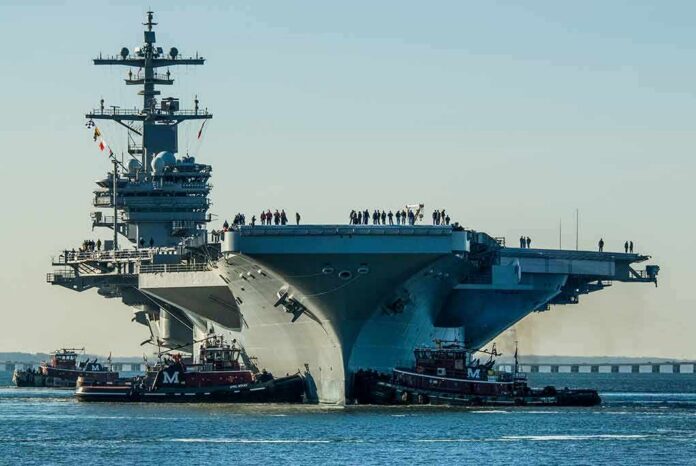
A record 265 straight days at sea ended as the USS Abraham Lincoln sailed into San Diego to thunderous cheers from thousands of families.
Story Highlights
- The carrier returned after roughly 321–322 days deployed, including 265 days without a port visit.
- Families lined the pier with flags as sailors and Marines reunited after nearly 11 months.
- New fathers met babies born during the deployment; dozens were counted across the ship and air wing.
- Defense Secretary Pete Hegseth awarded a Presidential Unit Citation, marking historic service.
Carrier Homecoming Marks Record Stretch At Sea
Reporters on the pier in San Diego described a sea of flags, tears, and hugs as the USS Abraham Lincoln came home after more than 10 months away. The deployment lasted about 321 to 322 days in total, with 265 days in a row without a port call, which multiple outlets reported as a modern record for a United States carrier. Families cheered as thousands of sailors crossed the brow. The return capped a mission that tested crews and loved ones but ended with a safe homecoming.
The Associated Press reported thunderous cheers as sailors stepped off the ship, while network crews showed long lines of families holding signs and American flags. The scale of the reunion spoke to the size of the Lincoln team, which typically includes the ship’s crew, an embarked air wing, and Marines. While estimates vary by outlet, coverage consistently noted a massive crowd and a powerful scene of relief and pride as the strike group wrapped up its work.
Mission Extended Amid Middle East Operations
The Jerusalem Post reported the Lincoln left San Diego in November 2025 for a shorter rotation but was redirected to Middle East duty after United States and Israeli operations against Iran began on February 28. That shift pushed the deployment well past the Navy’s usual seven to eight months. ABC News and the Associated Press documented the two key figures that define this cruise: roughly 321 to 322 total days deployed, and 265 straight days with no port stop. Those numbers explain the strain and the pride on display at the pier.
Defense Secretary Pete Hegseth presented a Presidential Unit Citation on October 7, calling out the crew’s historic performance, according to the Los Angeles Times. The award is the nation’s highest unit-level honor. It signals that leaders judged the Lincoln’s actions as exceptional under combat-related conditions. The formal recognition paired with the homecoming gave families a clear message: the long months mattered, the mission counted, and the nation noticed.
Families Shoulder The Load While Sailors Stand Watch
The Associated Press said some sailors met children born while they were away, a reminder of the cost that long deployments place on young families. The Jerusalem Post reported a tally that included 122 new fathers when counting the carrier and air wing, with 64 serving aboard the ship itself. Researchers have found that strong family support can help service members cope with stress, and large, visible welcomes can boost morale after extended time at sea. These reunions showed that truth in real time.
U.S. Sailors man the rails as Nimitz-class aircraft carrier USS Abraham Lincoln (CVN 72) returns to its homeport of San Diego following 10 months of operations in the U.S. 5th and 7th Fleet areas of operations.https://t.co/kckevy60bf pic.twitter.com/LXrmePtSpl
— USA Patriotism! (@USAPatriotismOg) October 11, 2026
The Navy has worked for years to keep carrier deployments closer to seven months, but urgent operations can stretch plans. ABC News placed the Lincoln’s total near 321 days, while the Associated Press wrote 322; both agreed on 265 consecutive days without a port visit. That distinction matters. The total deployment ran nearly 11 months, but the “no-port” streak explains why the crew’s endurance drew headlines. The figures differ slightly by outlet, yet the core record stands.
Why This Matters For Readiness And Values
Americans expect a strong Navy that finishes the job and comes home proud. This return showed that strength. The mission ran long because real-world threats demanded it, and the Lincoln’s crew answered. That is what deterrence looks like. It also showed why predictable deployments and solid logistics matter. Crews need clear cycles to train, fight, and reunite with family. Leaders awarded the unit for excellence, and the families who waited that long also earned the nation’s thanks.
Sources:
wcax.com, latimes.com, jpost.com, actionnewsjax.com, newscord.org