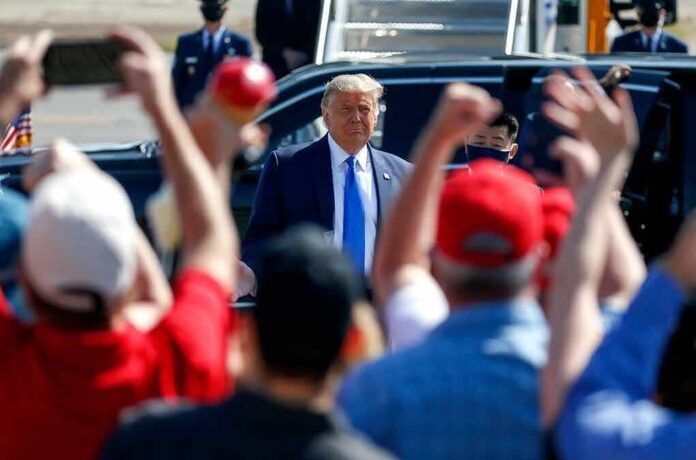
President Trump said he expects a first-ever meeting with Xi Jinping and Vladimir Putin at the APEC summit in China this month, signaling high-stakes talks on security and trade.
Story Highlights
- Trump said he expects to meet Xi and Putin in Shenzhen during the November 18–19 APEC summit.
- Beijing said it is in communication with relevant parties about a three-leader meeting.
- The Kremlin said organizing work is under way and called the idea useful.
- The agenda could include denuclearization, trade, and conflict issues.
Trump Signals Trilateral Talks On Security, Trade, And Conflict
President Trump told reporters he expects to meet China’s Xi Jinping and Russia’s Vladimir Putin on the sidelines of the Asia-Pacific Economic Cooperation leaders’ summit in Shenzhen on November 18–19. He said discussions could cover denuclearization and other major issues, including trade and efforts tied to conflict zones. Trump framed the talks as practical steps to reduce global danger and restore stability, with the summit offering a set time and place for high-level decisions.
Trump’s statement set a clear diplomatic marker while keeping room to maneuver. He used the phrase “I think,” which signals expectation rather than a final schedule. That approach is common before sensitive meetings. Leaders often float the format to test reactions and shape terms. The Shenzhen venue anchors the idea in a real event with built-in security and staff support. This makes side meetings easier to stage quickly if all parties agree.
Beijing Confirms Talks About A Three-Leader Format
China’s Foreign Ministry said it is in contact with relevant parties about a meeting among the three heads of state. That public note shows Beijing is engaging on logistics and format while keeping final decisions close. China hosts APEC this year, so it controls rooms, timing, and protocol. A careful public line lets Beijing guard its interests and avoid a rushed script. It also keeps pressure on Washington and Moscow to accept China’s conditions.
Analysts say China sees both risks and benefits. A successful photo and calm message would show China’s clout as a convener. But an open debate over Ukraine, trade, or nuclear issues could force choices China wants to avoid. Reports describe Beijing as cautious about a broad agenda while still calling the idea historic. That tact fits China’s style: confirm contact, shape details behind closed doors, and reveal outcomes late in the process.
Moscow Backs The Idea And Pushes Organization Forward
The Kremlin said work is under way to organize the possible meeting and described a trilateral as appropriate and useful. That public stance puts Russia on record in favor of a three-way format. It also suggests Moscow believes the talks could shift the war-and-sanctions map, or at least recast narratives before global audiences. Russia’s message lines up with a broader effort to show it can still sit at top tables with Washington and Beijing.
Reports tie Russia to early summit feelers and note that Moscow views a trilateral as a way to explore Ukraine-related paths alongside broader security issues. While the exact agenda remains open, a three-leader setting creates space to discuss ceasefires, arms limits, and trade stability. That said, final attendance details and the meeting’s structure were not formally announced at the time of reporting, even as organization progressed.
Why This Matters For Conservatives: Strength, Clarity, And Peace Through Power
A direct Trump-Xi-Putin meeting could advance a core conservative goal: peace through strength. Face-to-face talks can press China on fair trade and hold Russia to real-world costs. A focus on denuclearization guards American families from rogue threats and keeps our troops out of endless conflicts. The APEC setting also lets the United States press for cheaper energy and stable shipping, which help lower prices at home and break the cycle of inflationary shocks.
Conservatives should also watch how the agenda is set. An American-led push for security and free, fair trade serves our workers and farmers. Clear boundaries protect our sovereignty and our allies without writing blank checks. If China seeks a scripted photo-op, Washington can insist on real substance. If Russia seeks a public-relations win, the United States can tie any progress to verifiable steps that reduce risk and stop wider war.
What To Watch Next In Shenzhen
Watch for a formal schedule from the White House and from Chinese organizers. Look for signals on topics: denuclearization, energy flows, trade balance, and conflict de-escalation. A short but focused meeting can still have impact if it sets guardrails and timelines. Even a brief session that reduces miscalculation risk helps our troops and our economy. The conservative test is simple: Does it make America safer, freer, and more prosperous right now?
Sources:
youtube.com, thediplomat.com, kyivpost.com, theage.com.au, japantimes.co.jp