
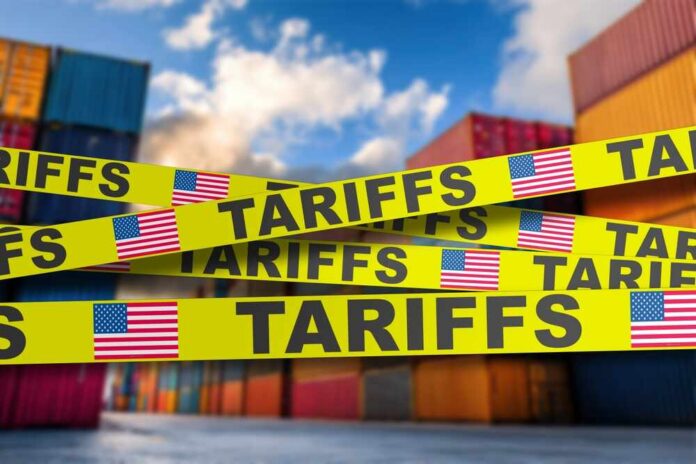
President Trump’s newly imposed 25% tariffs on European Union cars and trucks signal a dramatic escalation in trade policy that could reshape American manufacturing while hitting consumers’ wallets and straining decades-old alliances.
Story Highlights
- Trump formalized 25% tariffs on EU passenger vehicles, light trucks, and parts effective April 2025, with heavy-duty trucks following November 1
- The administration projects between $100 billion and $1 trillion in revenue over two years to reduce national debt and protect domestic automakers
- EU Commission President Ursula von der Leyen condemned the tariffs as “taxes bad for businesses, worse for consumers,” warning of potential retaliation
- American consumers face higher vehicle prices while domestic manufacturers gain short-term protection from foreign competition
Administration Invokes National Security Powers
Trump deployed Section 232 of the Trade Expansion Act of 1962 to justify the tariffs on national security grounds, arguing that dependence on foreign auto imports threatens American supply chains and manufacturing capacity. The White House proclamation covers imported passenger vehicles including sedans and SUVs, light trucks, and critical parts such as engines and transmissions. This represents the same legal mechanism Trump utilized during his first term for steel and aluminum tariffs, which triggered retaliatory measures from the EU on American bourbon and other products.
The timing caught many off guard, coming shortly after a positive diplomatic meeting between Trump and French President Emmanuel Macron. Trump justified the move by claiming the EU was created “in order to screw the United States” and pointing to the disparity between the EU’s 10% tariff on American vehicles versus the U.S. rate of 2.5% on passenger cars. However, no credible evidence supports Trump’s claim about the EU’s founding purpose, which emerged from post-World War II efforts to prevent future European conflicts through economic integration.
Economic Impact Creates Winners and Losers
American automakers including GM, Ford, and Stellantis stand to benefit from reduced foreign competition, potentially spurring domestic manufacturing expansion and job creation in line with “America First” policies. The administration touts this as reviving the industrial base that has eroded over decades of globalization. However, the protection comes with significant costs. Consumers face higher prices for vehicles and parts, adding inflationary pressure at a time when many Americans already struggle with the rising cost of living that has made the American Dream increasingly unattainable for working families.
The revenue projections reveal internal contradictions within the administration’s messaging. Trump has publicly estimated tariffs could generate $600 billion to $1 trillion, while White House staff offer more conservative estimates around $100 billion. This wide variance raises questions about the reliability of economic forecasting driving these policies. Meanwhile, European exporters, particularly German automakers, face severe market disruption. The tariffs also affect imports from Mexico, Canada, and Japan, straining relationships with key allies and trading partners beyond just the EU.
Trade War Risks Mount
The tariff announcement represents a significant gamble that could spiral into a destructive trade war. EU officials have indicated they will protect their interests, suggesting retaliatory measures may follow the pattern established during Trump’s first term. Von der Leyen’s swift condemnation signals Brussels will not simply absorb these costs without response. Such escalation could harm businesses on both sides of the Atlantic, disrupting global supply chains that have developed over decades and potentially triggering broader economic instability.
Trump says he's hiking tariffs on EU cars and trucks to 25% https://t.co/KV4cD3MSWN
— CBS Mornings (@CBSMornings) May 1, 2026
The staggered implementation timeline reveals the scope of this policy shift. Passenger vehicle and light truck tariffs took effect in early April 2025, while heavy-duty truck tariffs including medium and heavy commercial vehicles follow on November 1, 2025. This delay for heavy trucks affects critical infrastructure including delivery vehicles and semi-trucks, potentially rippling through logistics costs across the economy. For Americans watching their government, this episode reinforces a familiar pattern: bold policy moves that energize supporters who value protecting American workers, while critics warn of consequences that everyday families will bear through higher prices and potential job losses if trading partners retaliate. Whether this represents wise economic nationalism or reckless protectionism may depend on which side of the political divide you occupy, but the stakes for American competitiveness and consumer welfare are undeniably high.
Sources:
Trump Moves to Hit EU with 25% Tariffs on Cars and All Other Things – Dealership Guy
Trump Announces 25% Tariff on All Imported Medium and Heavy Duty Trucks – CBT News
Trump Auto Tariffs Impact on GM, Ford, Stellantis and Car Prices – CBS News