Trump says Iran is ready to talk—but he’s refusing to sign anything that can’t permanently block a nuclear breakout.
Quick Take
- President Trump says Iran “wants to make a deal” after roughly nine weeks of U.S.-Israeli fighting, but he’s “not satisfied” without stronger nuclear guarantees.
- A ceasefire has held since April 7, with no reported U.S.-Iran exchanges of fire, even as negotiations appear to be in a delicate phase.
- The administration is also navigating a War Powers Resolution deadline, with disagreement over whether the ceasefire pauses the clock.
- Trump’s stance echoes his long-running critique of the 2015 Iran nuclear deal, which he exited in 2018 as insufficient on missiles, inspections, and regional aggression.
Trump’s message: peace talks aren’t the finish line
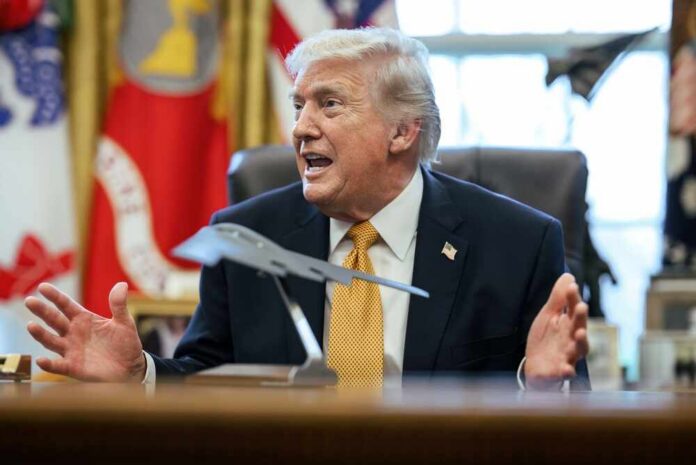
President Donald Trump said in late April 2026 that Iran “wants to make a deal” amid a ceasefire following about nine weeks of U.S.-Israeli military operations against Iran. Trump’s public position is that the U.S. has already achieved battlefield dominance—he cited destruction of Iranian naval and air capabilities and major damage to leadership structures—yet he is insisting on a final agreement with stronger assurances that Iran will never obtain a nuclear weapon.
Trump’s core demand—ironclad nuclear denial—fits a familiar American debate: whether a negotiated end to conflict is valuable if it leaves an adversary with pathways to rebuild. He argued that ending the fight without the right terms risks giving Tehran time to recover, and he estimated Iran could take decades to reconstitute key capabilities if the United States withdraws now. Those claims are political messaging as well as strategic framing.
Why the 2018 JCPOA withdrawal still shapes today’s terms
The current negotiating posture can’t be separated from Trump’s May 2018 withdrawal from the Joint Comprehensive Plan of Action (JCPOA). Trump called the JCPOA “the worst deal ever,” arguing it failed to curb ballistic missiles, failed to address Iran’s regional behavior, and delivered sanctions relief without lasting restraints. After the exit, the U.S. reimposed sanctions across major Iranian sectors, seeking leverage through economic pressure rather than a time-limited nuclear pause.
Iran’s response after 2018 also matters to the public’s trust in any new agreement. Multiple summaries indicate Iran exceeded JCPOA enrichment limits and reached 60% enrichment—close to weapons-grade—while it indicated no confirmed weaponization effort before the 2026 war. That distinction is crucial: enrichment capability can shorten a breakout timeline even without a proven bomb program, which is why verification and enforcement mechanisms become the real test of any deal.
Ceasefire stability meets War Powers pressure in Washington
The ceasefire reportedly has held since April 7, and it notes no U.S.-Iran exchanges of fire since then. At the same time, the administration is approaching a War Powers Resolution deadline, with Secretary of Defense Pete Hegseth arguing the legal clock is paused during the ceasefire. That legal dispute matters because it can shape negotiating leverage: a White House under tighter congressional constraints may have less room to sustain pressure if talks stall.
What “a better deal” means for Americans beyond foreign policy
For conservatives focused on national sovereignty and deterrence, Trump’s “not satisfied” posture reflects a preference for measurable outcomes—verification, bans, and enforcement—over diplomatic optics. For liberals worried about escalation, the same posture raises questions about how victory is defined and who decides when enough is enough. The available research also flags uncertainty: some battlefield claims and related reporting were described as not fully confirmed by other U.S. authorities in real time.
What to watch next: guarantees, enforcement, and the cost of failure
The near-term risk is that talks bog down while each side tests the other’s red lines, increasing the odds of renewed conflict despite the current pause. The longer-term stakes are broader than one negotiation: energy markets can react to instability around Gulf shipping lanes, and nuclear nonproliferation credibility depends on whether enforcement is real rather than symbolic. The research does not show a signed agreement as of late April 2026, so the next steps will likely hinge on verification terms and congressional dynamics.
🚨 Trump: Iran wants to make a deal; but I'm not satisfied with it (referring to the offer they submitted through Pakistan).
— Middle East Conflict Tracker (@MEC_Tracker) May 1, 2026
Americans across the political divide are also watching for a familiar pattern—grand promises followed by bureaucratic drift. In a moment when many voters believe Washington serves entrenched interests first, the public will judge outcomes the old-fashioned way: whether the deal is enforceable, whether it prevents a nuclear crisis years down the road, and whether elected officials prioritize security over headlines. The facts available so far point to a ceasefire, pressure, and unresolved terms.
Sources:
Iran war live updates: Trump, Strait of Hormuz, Israel-Lebanon ceasefire