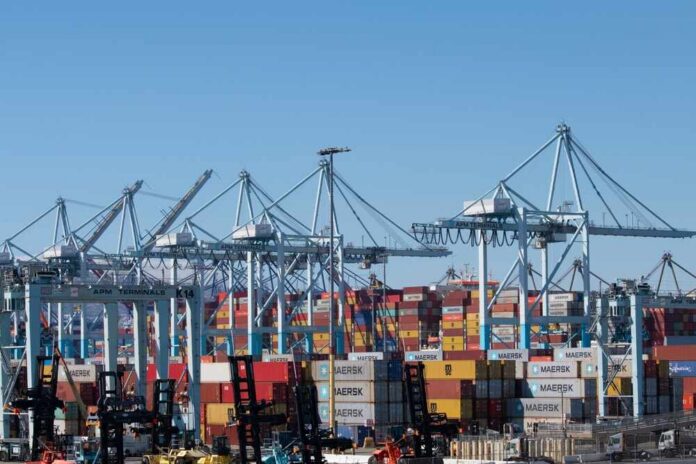
The Justice Department’s new Trade Fraud Task Force is rolling out its largest-ever crackdown on tariff cheats, aiming straight at companies that lied about what they ship into America.
Story Snapshot
- The Trade Fraud Task Force, created in 2025, now anchors the largest trade fraud crackdown yet.
- Justice Department officials say they have already recovered about $140 million, with more cases in the pipeline.
- The Task Force targets misclassification, false country-of-origin claims, undervaluation, and transshipment schemes that hurt U.S. workers.
- Trade fraud is now treated as a crime, not just a paperwork issue, with increased use of federal criminal statutes.
Trump-Era Task Force Drives “Largest-Ever” Crackdown
The United States Department of Justice launched the cross-agency Trade Fraud Task Force in late August 2025 to fight tariff evasion and customs fraud that threaten American jobs and national security. The Task Force brings together the Justice Department’s Criminal and Civil Divisions with the Department of Homeland Security, including United States Customs and Border Protection and Homeland Security Investigations. Officials describe the effort as a central pillar of President Trump’s America First Trade Policy, focused on stopping foreign and domestic players who cheat on duties and undercut honest American companies.
Senior Justice Department lawyer Cody Herche, now the head of the Trade Fraud Task Force, has said the department has already recovered about $140 million in trade fraud settlements, with many more investigations moving forward. He explained that the Task Force marks a shift from treating trade fraud as a minor regulatory issue to seeing it as serious economic crime. Trade fraud, including customs violations and tariff evasion, is now framed as a direct threat to United States economic and national security and to be met with aggressive enforcement.
How the Crackdown Works and Who It Targets
Justice Department officials have made clear which schemes they are going after. Herche and other leaders say the Task Force is focused on misclassification of goods, false country-of-origin declarations, undervaluation of shipments, and transshipment through third countries to dodge higher tariffs. These tactics allow importers to pay less than they owe or sneak in goods that should not enter the country. The Task Force also addresses smuggling of prohibited items and goods tied to forced labor or violations of Buy America rules, linking trade fraud to broader product safety and human rights concerns.
The Task Force does not operate alone. It coordinates tightly with agencies responsible for safety and standards, including the Food and Drug Administration, the Environmental Protection Agency, and the Consumer Product Safety Commission. These partners help flag cases where forged safety or environmental certifications are used to bring non-compliant or dangerous goods into the country. By tying customs fraud to safety and forced labor issues, the crackdown aims to protect American families, workers, and consumers while supporting domestic producers who follow the law.
From Civil Fines to Criminal Cases
For many years, most customs and tariff problems were handled as civil matters, often with simple duty collection or modest fines. Under the Trump administration’s America First agenda, the Trade Fraud Task Force now pushes harder use of criminal tools. Herche has highlighted a strategic shift toward using criminal statutes such as 18 U.S.C. Sections 541, 542, and 545, which cover false statements, smuggling, and importation by fraud. This means corporate officers and managers who knowingly cheat on tariffs could face criminal charges, not just company-level settlements.
The Justice Department has already shown it will pursue both civil and criminal tracks at the same time when needed. In late 2025, two major enforcement actions announced on the same day combined recovery of unpaid duties with more than $30 million in civil penalties, reinforcing that trade fraud is now a top-tier enforcement priority. Law firms that advise importers are warning their clients that enforcement has intensified and that the Task Force represents a structural escalation, especially for companies that rely on complex global supply chains or high-tariff goods.
Data Mining, Whistleblowers, and Due Process Concerns
This crackdown relies heavily on data and tips. Justice Department officials say the Task Force uses Customs and Border Protection’s Automated Targeting System to scan shipping data for unusual patterns and “data shifts” that may suggest false statements or undervaluation. At the same time, the department has expanded its Corporate Whistleblower Program, inviting insiders and even data analysts to report suspected trade fraud and tariff evasion. Hundreds of whistleblower lawsuits have already been filed in related areas, helping generate leads for investigators.
DOJ Assistant AG Colin McDonald announces in the last 98 days have busted over 900 fraud schemes.
Today the Trade fraud task force has officially surpassed $1 billion in criminal & civil recoveries, penalties, forfeitures, & charged losses.Trump DOJ will find & prosecute you.
— COCOBIRD in Tucson (@Cocobird__1) July 14, 2026
Some legal analysts note that enforcement filings in 2026 remain relatively modest compared with the scale of the data and tips flowing in, and one client alert even described a “quiet quarter” in terms of public cases, despite growing risk. Others warn that heavy reliance on statistical anomalies and financially motivated whistleblowers can raise questions about fairness, especially when headlines brand the crackdown as “largest-ever” before specific defendants and evidence are tested in court. Still, Justice Department leaders insist that every case must meet legal standards and that the Task Force’s goal is simple: stop fraud, defend American workers, and make those who cheat on tariffs pay up.
Sources:
facebook.com, justice.gov, mayerbrown.com, shb.com, whitecase.com, finance.yahoo.com, akingump.com