
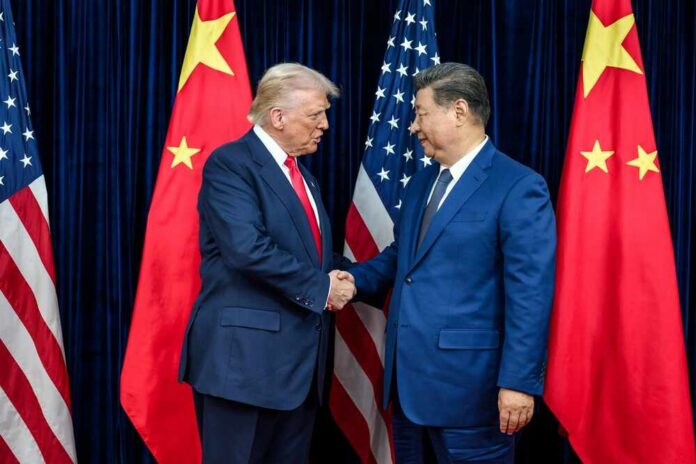
China’s rise turned a once-manageable relationship into a high-stakes contest that now reaches from missiles and semiconductors to trade and technology.
Quick Take
- U.S. policy now openly treats China as a **strategic competitor**, not a routine diplomatic challenge.[1][3]
- Major policy analysis says China’s military buildup is designed to weaken U.S. power in Asia and shape the future balance.[2]
- Think tanks describe the rivalry as a **multi-domain competition** spanning military, economic, technological, diplomatic, and ideological fronts.[3]
- U.S. export controls on advanced chips and manufacturing equipment show Washington already views China’s tech rise as a national-security threat.[5]
How the Relationship Changed
The modern U.S.-China rivalry did not appear overnight. According to Brookings, Washington’s language shifted from seeing Beijing as a potential partner to calling it a “strategic competitor,” while the December 2017 National Security Strategy marked a more explicit turn toward competition and deterrence.[1][3] That shift matters because it changed the official lens through which trade, diplomacy, military planning, and technology policy are all now judged.
Historical context also helps explain why the dispute feels so broad. The United States and China once cooperated in the 20th century, but the relationship after normalization became marked by persistent disputes over economics, power, and influence.[4][6] Today, the contest is not limited to tariffs or talking points. It is a long-running struggle over who sets the rules in the Pacific and who controls the technologies that will matter most in the next decade.
Military Competition Drives the Hard Line
The sharpest warnings come from the military balance. Carnegie’s analysis says China’s modernization seeks “Indo-Pacific regional hegemony in the near-term and displacement of the United States to achieve global preeminence in the future,” and it ties that effort to the lessons Beijing drew from the 1995–96 Taiwan missile crisis.[2] That history suggests China has spent years building capabilities intended to make U.S. intervention around Asia more difficult, costly, and uncertain.
Belfer Center analysis of the RAND military scorecard says that by 2017 China would have an “advantage” or “approximate parity” in six of nine conventional mission areas in a Taiwan or South China Sea conflict.[2] The same analysis says later RAND work found the balance continuing to tilt toward China, with U.S. forward-basing becoming more vulnerable and direct defense of U.S. interests potentially more expensive.[2] That is the kind of trend Washington cannot ignore.
Technology, Trade, and Supply Chains Became Battlefields
The rivalry now extends far beyond ships and missiles. The Center for Strategic and International Studies says the United States and China are engaged in a “sprawling competition” across military, economic, technological, diplomatic, and ideational domains, and it says the relationship is unlikely to end soon.[3] That framing matches what Americans have seen in practice: tighter export controls, pressure on supply chains, and a growing fight over who leads in advanced computing, artificial intelligence, and semiconductor manufacturing.
Latin America at a crossroads: Resources, austerity, and global power shifts – June 2026
✲ Core overview: Latin America is not in open revolt, but it is bargaining hard.
• Three structural forces overlap – US-China rivalry over critical minerals, domestic fiscal crises… https://t.co/rPpjpcszLD pic.twitter.com/4i0yx3AMFv— Yashika Suri (@Yashika10614068) June 4, 2026
U.S. export controls on advanced computing and semiconductor manufacturing items in October 2022 were designed to counter China’s “accelerating advancement” in high-tech capabilities and to inhibit military buildup.[5] In plain terms, Washington is no longer treating this as a normal trade dispute. It is treating Chinese technological progress as a national-security issue because modern war, industrial power, and economic leverage are all now tied together.
What the Record Shows, and What It Does Not
The public evidence is strong on competition, but it is not equally strong on every claim about intent. Much of the most serious material comes from think-tank synthesis, policy essays, and scenario-based assessments rather than from direct Chinese internal documents proving a single master plan.[2][3][6] That means the case for rivalry is solid, but some of the strongest conclusions still rest on interpretation of behavior, force posture, and capability trends rather than on a public confession of long-term goals.
Even so, the policy response is already visible. Once Washington starts using export controls, defense planning, and alliance strategy to slow a rival’s rise, it signals that the competition is real and enduring.[3][5] For readers who want the short version: the U.S.-China contest began with history, hardened through military modernization, and now runs through the technologies and supply chains that will shape American power for years to come.
Sources:
[1] Web – The history behind the U.S. competition with China
[2] Web – Strategic Competition and US–China Relations: A Conceptual …
[3] Web – [PDF] The Return of U.S.-China Strategic Competition
[5] Web – Advancing U.S.-China Coordination amid Strategic Competition – CSIS
[6] Web – China Strategic Competition and the Role of Transatlantic Cooperation