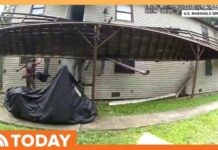

As Palisades families rebuild after wildfire, thieves are targeting vacant lots and stripped homes for metal and materials while officials struggle to secure the recovery zone.
Story Highlights
- Uneven rebuilding has left many properties exposed, creating openings for opportunistic theft [1].
- City emergency orders exist on paper, but on-the-ground delays keep sites vulnerable for months [2][3].
- Local commentary and resident posts describe copper and material theft amid partial construction [1].
- Some progress is visible, complicating claims of pervasive looting across the entire neighborhood [4][5].
Rebuilding Gaps Create Targets for Opportunists
YouTube reporting from the neighborhood states that roughly 400 permits are in circulation while only a fraction of destroyed lots have moved through the process, leaving long stretches of damaged or vacant properties exposed to trespassers and materials theft [1]. Conservative homeowners who played by the rules now face a second hit: supplies disappearing from pads, wiring stripped from frames, and tools walking off when crews rotate. The pattern follows common-sense criminology—empty sites invite scavengers when guardianship is thin.
Los Angeles City Planning documents outline emergency executive orders from state and city leaders meant to streamline rebuilding, but implementation does not erase street-level delays, inspections bottlenecks, or the simple fact that many lots sit open for weeks between milestones [2]. The Los Angeles Times described debris removal at the Palisades Bowl Mobile Home Estates only “finally” getting underway, underscoring the slow grind that leaves properties semi-secured and easier to hit for copper and equipment theft [3]. When government timing lags, criminals fill the gap.
What the Evidence Shows—and What It Doesn’t
Local interviews and footage capture active construction side by side with skeletal frames and tarped foundations, a patchwork that explains why residents report theft even as parts of the Palisades march forward [1]. Realtor.com highlighted the first rebuilt home receiving a certificate of occupancy and noted hundreds of projects underway, which weakens any claim that the entire area is a free-for-all [4]. A 2024 local news segment also showed significant progress, suggesting conditions vary block to block rather than proving uniform lawlessness [5].
Broader disaster-recovery analyses warn that the interval between destruction and full re-occupation is when property crime risk rises: residents are displaced, normal guardianship collapses, and contractors cycle through unsecured sites [6]. County recovery pages and city planning guidance confirm a formal recovery architecture, but paperwork alone does not harden a garage or guard a pallet of copper [8][2]. The prudent conclusion is targeted vulnerability, not blanket collapse—serious enough to demand action, specific enough to fix.
Accountability, Security, and Common-Sense Fixes
City records and county resources acknowledge the scope of the rebuild yet do not provide incident-level counts of theft, leaving residents to rely on reports, social media posts, and on-site experiences when tools or wiring disappear [8][1]. That information gap frustrates homeowners who want basic protection for property rights while they navigate permits, inspections, and rising costs. Conservatives see the core issue clearly: when government speed and transparency lag, criminals exploit the vacuum, and families pay twice.
Homeowners can harden their sites while pressing authorities for results. Builders can lock supply cages, etch identifiers on metals, and use motion lighting and cameras, but visible policing and swift debris clearance remain essential deterrents. Officials should publish timely theft statistics, coordinate patrols during known downtime windows, and require verifiable security plans as a permit condition in high-risk phases. Protecting property is not partisan—it is a constitutional expectation anchored in the rule of law and equal justice.
Sources:
[1] Web – Opportunist ghouls looting stricken Palisades residents as they try to …
[2] YouTube – The Rebuilding Problem No One Is Talking About
[3] Web – Palisades Rebuild and Recovery – Los Angeles City Planning
[4] Web – Wildfire debris removal underway at Palisades Bowl Mobile Home …
[5] Web – L.A. Unveils First Home Rebuilt After Palisades Fire – Realtor.com
[6] YouTube – Pacific Palisades homeowner talks rebuilding process
[8] Web – Los Angeles issues only 4 permits to rebuild homes after …