
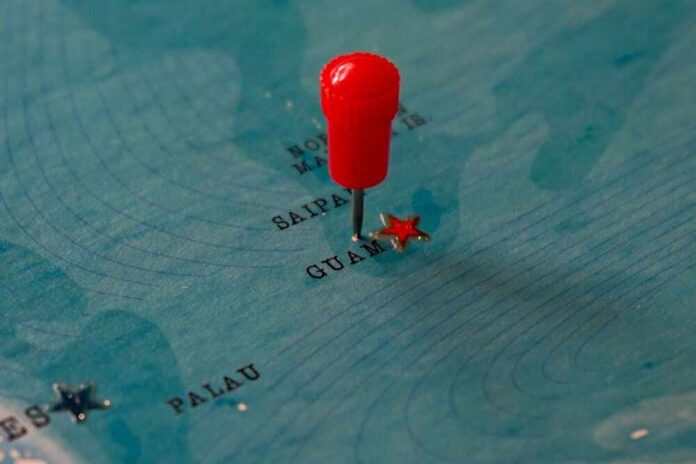
China’s latest deep-sea test proves it can sever undersea cables at 3,500 meters, placing Guam’s vital fiber-optic lines—lifelines for U.S. military defenses and global internet—at direct risk from Beijing’s advancing asymmetric warfare capabilities.
Story Snapshot
- Chinese vessel Haiyang Dizhi 2 successfully tested an electro-hydrostatic actuator (EHA) capable of cutting submarine cables at record 3,500-meter depths on April 11, 2026.
- Guam’s 12 fiber-optic lines, serving U.S. DoD, Google, and the Second Island Chain, face heightened vulnerability in a potential Indo-Pacific conflict.
- State media touts civilian uses like pipeline repair, but experts warn of dual-use military sabotage threatening 95% of global internet traffic.
- Test signals deployment readiness, escalating U.S.-China tensions amid Trump’s America First push to secure Pacific defenses.
Test Details and Capabilities
The Haiyang Dizhi 2, a research vessel under China’s Ministry of Natural Resources, completed the first full-depth sea trial of an electro-hydrostatic actuator on April 11, 2026. This compact device integrates hydraulics, electric motors, and controls to withstand extreme pressure and corrosion. It performed precise cutting operations at 3,500 meters, depths where most submarine cables lie. State media celebrated bridging the gap from prototype to engineering application. Prior tests in September 2025 demonstrated cable-cutting and grabbing functions.
Strategic Threat to U.S. Pacific Defenses
Guam’s 12 fiber-optic cables anchor the Second Island Chain, connecting Guam to Palau and supporting U.S. military communications, Google services, and regional internet. These lines carry 95% of global data traffic, making them prime targets. The EHA’s proven precision enables sabotage that could blackout communications, disrupt defenses, and cripple operations without direct combat. U.S. Department of Defense expansions in the Marianas highlight urgency, as China maps waters around Guam for submarine and disruption plans.
Dual-Use Technology Amid Rising Tensions
China frames the EHA for civilian deep-sea tasks like oil and gas pipeline construction. International analysts, however, identify clear military implications in a new domain of modern warfare. Past incidents, including suspected Chinese vessel damages near Taiwan and Russia’s Baltic cuts, underscore precedents. Amid U.S.-China rivalry over Taiwan and the South China Sea, this capability bolsters Beijing’s hybrid warfare options. President Trump’s administration faces Democratic obstruction while fortifying alliances like AUKUS and QUAD.
In 2026, with Republicans controlling Congress, frustrations mount on both sides over federal failures. Conservatives decry globalist vulnerabilities exposing America to threats like this; liberals worry about escalating divides. Yet both recognize elite deep state priorities often eclipse securing the American Dream through strong defenses and limited entanglements.
China Just Proved It Can Cut Undersea Cables at 3,500 Meters Deep. Guam’s 12 Fiber-Optic Lines Serve Google, the U.S. Military and the Entire Second Island Chainhttps://t.co/lEbpnCyWSD
— 19FortyFive (@19_forty_five) April 19, 2026
Implications for National Security
Short-term, the test prompts intensified U.S. cable monitoring and hardening. Long-term, it risks billions in daily economic losses from outages, service disruptions in Pacific islands, and weakened deterrence. Telecom firms rush redundancies and armoring; defense eyes satellite backups. This deep-sea race tests America’s resolve to maintain undersea superiority, vital for individual liberty and sovereignty against foreign aggression.
Sources:
China tests submarine cable cutter at 3500-metre depth
China tests deep-sea electro-hydrostatic actuator that can cut undersea cables
New domain in modern warfare: China’s deep-sea cable cutter test