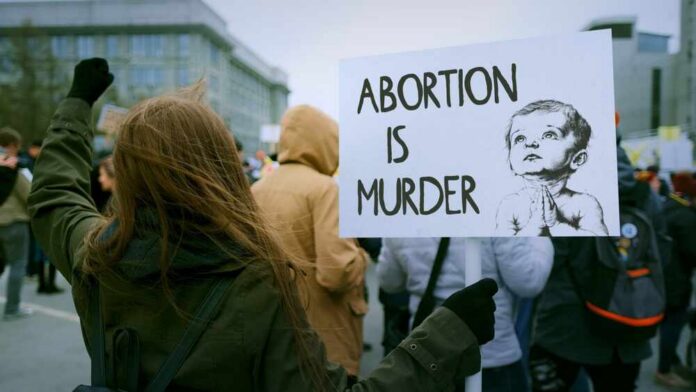
President Trump’s biggest pro-life problem right now isn’t the left—it’s a faction of the anti-abortion movement demanding an all-or-nothing agenda.
Story Snapshot
- Hardline anti-abortion activists are publicly signaling frustration with Trump, arguing he isn’t delivering a total national ban.
- The split comes even after Trump-era legal and enforcement changes that critics say weakened protections around abortion facilities.
- Legal strategists allied with Trump have promoted using the Comstock Act to restrict abortion nationwide without new legislation.
- Separately, abortion politics is bleeding into health-care fights, with lobbying pressures shaping GOP debates over ACA provisions.
Purist activists say Trump is “the problem,” not the solution
Reporting out of the national press describes a growing rift between President Trump and absolutist anti-abortion organizers who want zero exceptions and maximal federal action. In that telling, leaders such as activist Charlie Rose have argued Trump is failing to match their uncompromising demands and have warned that ignoring them could carry electoral consequences. The key takeaway is less about whether Trump is “pro-life” and more about who gets to define the movement’s bottom line.
Trump’s political reality is that he leads a coalition, not a church synod. After the post-Roe landscape pushed abortion policy into state legislatures and courts, the federal role became a contest over enforcement tools, administrative decisions, and judges—areas where activists often expect immediate, sweeping outcomes. That mismatch helps explain why a president can be celebrated for past wins yet still face accusations of betrayal from purists who view anything short of a full national ban as surrender.
DOJ enforcement choices and FACE Act moves fuel a new round of conflict
The administration’s 2025 actions around the Freedom of Access to Clinic Entrances (FACE) Act became a flashpoint. According to advocacy reporting, Trump issued pardons for 23 FACE Act violators on January 23, 2025, and the Justice Department then moved to drop related prosecutions. DOJ leadership under Pam Bondi and Harmeet Dhillon also signaled a shift toward using the statute to protect crisis pregnancy centers rather than abortion clinics, reshaping enforcement priorities in a highly polarized space.
Critics tie those decisions to rising security concerns around abortion facilities, pointing to sharp increases in harassment, threats, and obstruction after Dobbs. The available figures come from advocacy groups, so readers should treat them as non-neutral but still relevant indicators of what those groups are tracking and litigating. Even so, the bigger governance issue is straightforward: when federal enforcement pivots by ideology, trust in equal protection under the law erodes for half the country.
The Comstock Act strategy raises high-stakes questions about executive power
Another major pressure point is a legal strategy reportedly promoted by Jonathan Mitchell, a former Trump-linked lawyer and architect of Texas’ S.B. 8 enforcement model. The plan centers on using the federal Comstock Act—an old law restricting the mailing of abortion-related materials—as a pathway to constrict abortion nationwide without Congress passing a new ban. The ACLU characterizes this approach as an “existential threat,” emphasizing that proponents understand a direct national ban is politically unpopular and therefore pursue quieter routes.
For conservatives who value limited government and constitutional clarity, this debate is a double-edged sword. Many voters want abortion policy aligned with traditional values, but using executive-branch interpretation to achieve what Congress cannot pass invites the same complaint conservatives often make about progressive governance: rule by bureaucracy and legal workaround rather than transparent legislation. When either side treats the administrative state as a shortcut, the result is more national volatility, more litigation, and less democratic accountability.
Abortion politics is reshaping health-care fights beyond the abortion question
The abortion divide is also spilling into broader health-care policy, including battles over Affordable Care Act (ACA) provisions and premium supports. Reporting describes how anti-abortion lobbying influences Republican resistance to certain ACA expansions, complicating debates over insurance affordability and federal spending. That creates a difficult trade: restraining federal outlays and rejecting mandates may satisfy limited-government instincts, but abrupt changes can also raise costs for middle-income families already squeezed by inflation.
The Anti-Abortion Lobby Is 'Turning on Trump' as Activists Accuse President of Being 'the Problem': Report https://t.co/j7EQoWks7O
— Mediaite (@Mediaite) May 4, 2026
Politically, the emerging split underscores a recurring frustration on both right and left: organized factions attempt to steer federal power toward uncompromising goals, while ordinary citizens pay the price in social conflict, legal uncertainty, and nonstop campaigning. Trump still benefits from a GOP-controlled Congress, but intramural warfare can narrow governing room fast. The immediate question is whether the White House tries to satisfy purists with tougher federal action—or keeps a more pragmatic stance to avoid a wider national backlash.
Sources:
Seeking Transparency: Trump “Greenlighting Violence” Against Abortion Providers & Patients
Trump, Republicans in Congress, ACA premium tax credits, insurance costs, price increases, abortion
America’s anti-abortion lobby begins to lose faith in Donald Trump