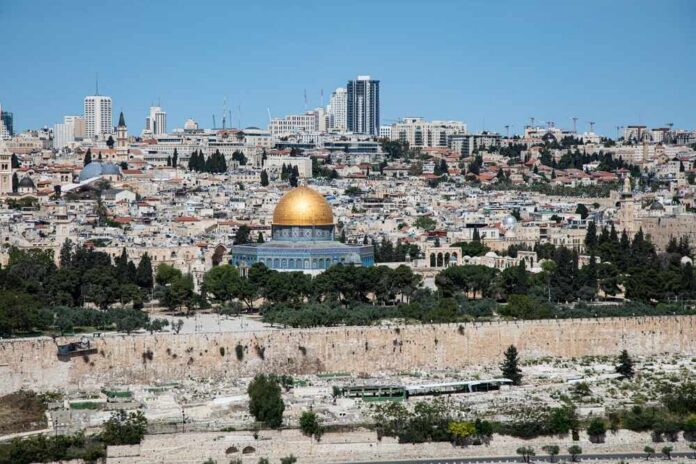
Thousands of Israeli nationalists marched through Jerusalem’s Old City on Jerusalem Day, with far-right minister Itamar Ben Gvir raising an Israeli flag on the Temple Mount — an act that ignited fresh tensions across one of the world’s most contested pieces of land.
Story Highlights
- Thousands of Israeli nationalists completed the annual March of Flags through Jerusalem’s Old City Muslim Quarter on May 14, 2026.
- Far-right National Security Minister Itamar Ben Gvir ascended to the Temple Mount and raised an Israeli flag during the holiday.
- Israel captured East Jerusalem in the 1967 Middle East war and later annexed it, a move the United Nations and most countries have not recognized.
- Palestinian shop owners closed businesses and police erected barricades ahead of the march, while some participants were reported chanting “death to Arabs.”
What Is Jerusalem Day and the March of Flags
Jerusalem Day is an Israeli national holiday commemorating the capture of East Jerusalem — including the Old City — during the 1967 Middle East war. The annual March of Flags, also called the Dance of Flags, is the central public celebration of that event. The march begins in central Jerusalem, winds through the Old City’s Muslim Quarter, and concludes at the Western Wall with a mass prayer service. Tens of thousands of participants typically attend, waving Israeli flags throughout the route.
Israel formally annexed East Jerusalem following the 1967 war, declaring the city its unified and eternal capital. However, the United Nations and the vast majority of the international community have not recognized that annexation, leaving the city’s final status a central unresolved issue in the broader Israeli-Palestinian conflict. The march therefore carries dual significance: for Israeli supporters it is a religious and national celebration of historical proportion, while critics frame it as a sovereignty assertion inside a disputed territory.
Ben Gvir on the Temple Mount
National Security Minister Itamar Ben Gvir entered the Al-Aqsa compound on the Temple Mount under heavy Israeli security during the Jerusalem Day festivities and raised an Israeli flag there. The Temple Mount sits atop the Western Wall and houses the Al-Aqsa Mosque, one of Islam’s holiest sites. Visits by Israeli officials to the compound have historically triggered regional condemnation and, at times, violent unrest. Ben Gvir’s entry drew immediate international attention and criticism from multiple outlets covering the event.
Ben Gvir is a member of the Otzma Yehudit party, a far-right faction within Israel’s governing coalition. His decision to ascend the Temple Mount on Jerusalem Day fits a pattern of assertive moves at religiously sensitive locations that he and other coalition members have pursued. The timing — during a march already watched closely for security incidents — amplified the symbolic weight of the action and drew condemnation from Palestinian leaders and Arab governments who view such visits as deliberate provocations.
Security Measures and Reported Incidents
Israeli police deployed heavy security along the march route ahead of the event, erecting barricades near Damascus Gate and other entry points to the Old City’s Muslim Quarter. Palestinian shop owners in the area shuttered their businesses in anticipation of the march passing through. These precautions reflect a recurring pattern: reporting across multiple years has documented the same cycle of mass participation, police closures, and Palestinian shop shutdowns each time the march is held.
Ahead of the annual "Flag March," Israeli ministers and Members of Knesset raided Al-Aqsa Mosque on "Jerusalem Day," which marks Israel's 1967 occupation of East Jerusalem. pic.twitter.com/1N7Eycky8l
— Middle East Eye (@MiddleEastEye) May 14, 2026
During the march, some participants were reported chanting “death to Arabs,” according to coverage by the Times of Israel. Such incidents have drawn condemnation even from some Israeli voices. The march route through the Muslim Quarter remains the most contested element of the annual event, as it passes directly through a densely populated Palestinian residential and commercial area. Critics argue the route is chosen specifically for its provocative effect, while supporters maintain it is a legitimate public celebration through Israel’s capital city.
A Flashpoint With Broader Regional Stakes
The Jerusalem Day march does not occur in isolation. Regional actors, including Hezbollah in Lebanon, have historically used the event as a flashpoint for escalatory actions. Reports on the day noted a Hezbollah drone attack wounding civilians near Israel’s northern border as tensions surrounding the march intensified. For Israel’s allies, including the United States under the Trump administration, Jerusalem’s status as Israel’s recognized capital has been a cornerstone of Middle East policy since President Trump’s first term moved the U.S. Embassy there in 2018.
The march underscores the enduring complexity of Jerusalem’s status and the difficulty of separating religious observance, national identity, and geopolitical contestation in one of the world’s most disputed cities. For Israeli nationalists, the annual event is a non-negotiable expression of sovereignty. For Palestinians and much of the international community, it remains a visible reminder that the city’s final status has never been formally resolved. Both realities continue to collide every year on the streets of the Old City.
Sources:
[1] Web – Chants of ‘death to Arabs’ at Jerusalem Day march as Ben Gvir flies …
[2] Web – Israeli nationalists hold parade marking their capture of …
[4] Web – Israeli nationalists hold parade marking capture of East …
[5] Web – What is Jerusalem Day and the March of Flags?
[6] Web – Watch Live: Thousands Gather for Jerusalem Day Flag March
[7] Web – Israeli Nationalists Hold Parade Marking Their Capture of East …
[8] YouTube – Far-Right Israelis Carry Out ‘Jerusalem Day March’ In Old City