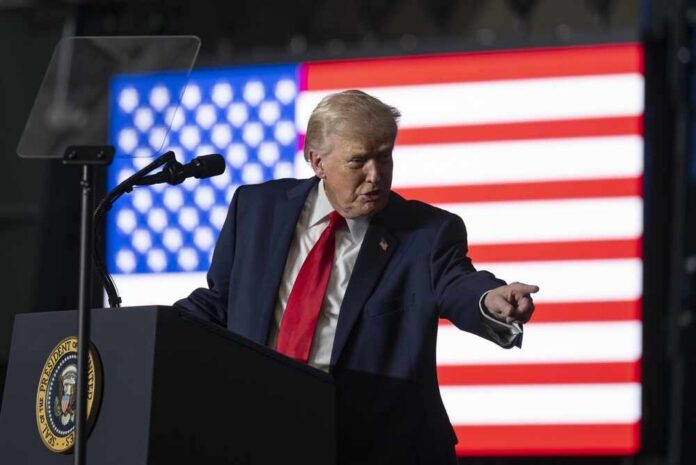
President Trump’s arrival in Beijing for a high-stakes summit with Xi Jinping places America’s economic and security interests on the line as trade wars, Taiwan tensions, and the Iran conflict converge in a moment that will define whether Washington can still negotiate from strength or watch its influence erode.
Story Snapshot
- Trump landed in Beijing at 7:51 a.m. ET for a two-day summit addressing trade imbalances, Taiwan arms sales, and Iran’s role in regional instability
- Nvidia CEO Jensen Huang accompanied the president aboard Air Force One, underscoring the critical stakes for America’s semiconductor industry worth trillions
- U.S. officials operate under strict digital lockdown protocols to prevent Chinese espionage during negotiations that could reshape global economic power
- The summit tests whether Trump’s “America First” approach can secure concrete wins or if Beijing will exploit U.S. distractions from multiple crises
High-Stakes Arrival Amid Multiple Flashpoints
Air Force One touched down at Beijing Capital International Airport on May 13 as President Trump embarked on his first state visit to China since 2017. The president’s delegation includes top corporate executives and advisors operating under heightened security measures designed to thwart Chinese intelligence gathering. This visit comes as Washington confronts a complex web of challenges: stalled trade negotiations, aggressive Chinese military exercises near Taiwan following recent U.S. arms sales, and Beijing’s diplomatic support for Iran amid escalating Middle East conflict. The simultaneity of these crises raises fundamental questions about whether American leadership can effectively manage competing priorities while maintaining strategic focus.
Tech Giants and Economic Leverage in Play
Jensen Huang’s presence on the presidential aircraft signals the critical intersection of national security and commercial interests that defines modern U.S.-China relations. Nvidia, valued at $5.3 trillion as the world’s most valuable company, derives roughly 20 percent of its revenue from Chinese markets despite Washington’s export restrictions on advanced semiconductors. Trump personally confirmed Huang’s participation after reports suggested his exclusion, demonstrating how corporate America’s fortunes remain tied to Beijing’s cooperation even as tariffs and technology bans proliferate. This dynamic creates tension between hardliners seeking full decoupling and business leaders advocating pragmatic engagement to preserve market access worth hundreds of billions annually.
Taiwan and Iran Complicate Negotiations
Recent U.S. approval of a $2 billion arms package to Taiwan prompted immediate Chinese military drills, raising the temperature on an issue Beijing considers non-negotiable. The Taiwan Relations Act commits Washington to providing defensive weapons, yet each sale triggers escalatory responses from the People’s Liberation Army that inch the region closer to miscalculation. Simultaneously, China’s diplomatic backing of Iran as ceasefire talks collapse adds another layer of complexity. Trump faces pressure to secure Chinese cooperation on restraining Tehran while knowing that Xi views Iran as a strategic counterweight to American influence in energy markets. These interconnected issues mean concessions on trade may require accepting Chinese intransigence elsewhere, testing the limits of transactional diplomacy.
Digital Lockdown Reflects Espionage Concerns
The mandatory digital lockdown imposed on U.S. officials reveals the depth of mistrust underlying this diplomatic engagement. American negotiators must surrender electronic devices or use secure equipment to prevent Chinese intelligence services from exploiting technology vulnerabilities. This precaution acknowledges Beijing’s sophisticated cyber capabilities and history of intellectual property theft through both hacking and human intelligence operations. For many Americans who watched manufacturing jobs disappear overseas while China benefited from technology transfers, such measures come decades too late. The surveillance risk underscores how economic interdependence with an authoritarian rival creates vulnerabilities that go beyond trade deficits to encompass national security fundamentals that cannot be easily reversed.
Trump’s reputation as a dealmaker faces its most consequential test as negotiations unfold over coming days. A substantive agreement addressing trade imbalances could provide economic relief to American exporters and consumers facing inflation from tariffs. However, past experience suggests Beijing excels at offering symbolic gestures while resisting structural reforms that would level the competitive playing field. Whether this summit produces genuine progress or merely provides political theater for both leaders remains the central question, with implications extending far beyond bilateral relations to America’s broader capacity to shape global events while managing domestic frustrations over government effectiveness and elite accountability.
Sources:
Iran War: US Trump-China Xi Summit, Ceasefire Peace Talks Stalled – CBS News
Video: US President Donald Trump Arrives in Beijing – CGTN