
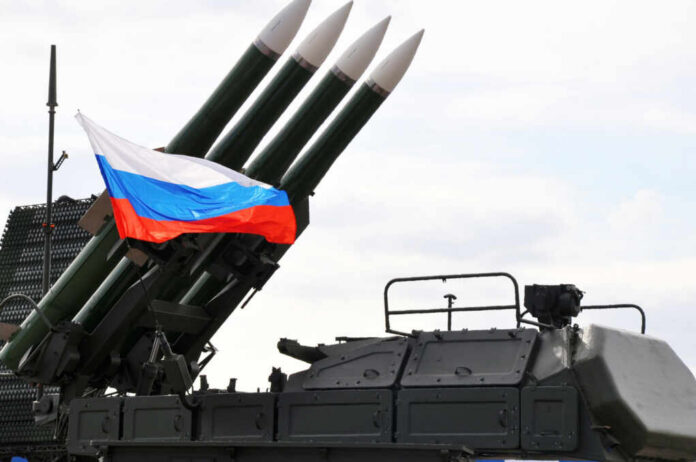
Russia is now accused of firing drone-launched missiles laced with depleted uranium at northern Ukraine, raising fresh questions about escalation, truth, and what Americans are really being told about this war.
Story Snapshot
- Ukraine’s Security Service says it recovered a Russian missile with depleted uranium components after a strike in Chernihiv.
- Radiation levels reportedly exceeded normal background enough to trigger a radioactive waste response.
- The allegation rests on Ukrainian wartime claims without publicly released lab data or independent verification.
- The story is already being weaponized in the media narrative that pressures the United States and NATO toward deeper confrontation with Moscow.
What Ukraine Says It Found on the Battlefield
Ukraine’s Security Service, the SBU, claims that after a recent Russian attack on Chernihiv Oblast, technicians recovered an unexploded R-60 air-to-air missile that had been mounted on a modified Geran-2 attack drone.[1] According to Ukrainian reports, radiation detectors showed elevated levels around the warhead, prompting a deeper inspection.[1] Officials then alleged the source was depleted uranium projectiles containing Uranium-235 and Uranium-238, an accusation that immediately triggered talk of “radiological escalation” in the region.[1][3]
Ukrainian emergency units reportedly treated the wreckage as a radiological hazard, securing the warhead and moving it to a designated radioactive waste storage facility for further analysis.[1][3] A gamma reading of about 12 micro-sieverts per hour was cited in coverage, said to be significantly above normal background and therefore a possible health risk.[1] A European outlet, TVP World, separately repeated the core claim that depleted uranium was found in a missile mounted on a modified Russian drone, attributing the information to Ukraine’s intelligence services.[4]
How Solid Is the Evidence Behind the Uranium Claim?
The central problem is that, so far, the public only sees secondhand descriptions of what the SBU says it detected, not the raw science. None of the reports provide an actual laboratory printout, spectrometry chart, or chain-of-custody record for the warhead and debris.[1][2][3] Media outlets are relaying the story based on SBU statements and anonymous Ukrainian officials. That is common in wartime, but it means everyone is being asked to trust a security service that is also a combatant and information actor in this conflict.[1][3]
No independent radiological authority is shown in the record confirming that the material was truly depleted uranium, as opposed to another uranium-bearing component or contamination.[1][3][4] The allegation names Uranium-235 and Uranium-238, but there is no disclosed isotope ratio or metallurgical teardown that would distinguish depleted uranium from natural uranium. Reports also differ slightly on timing, with some describing an April strike and others focusing on the May announcement, highlighting that the story is passing through multiple layers of wartime media before reaching the public.[1][3]
Escalation Narratives and Pressure on the United States
As this depleted-uranium story circulates, it feeds directly into a broader narrative that pushes Western governments, especially the United States, toward deeper confrontation with Russia. Coverage links the allegation to larger fears about nuclear escalation, pointing out that the North Atlantic Treaty Organization (NATO) leadership has warned of “devastating” consequences if Moscow ever uses nuclear weapons in Ukraine.[1] At the same time, Russia has showcased nuclear drills and movements of nuclear munitions to Belarus, underscoring just how much this war sits on a hair trigger.[1][6]
For American conservatives, the timing matters. After years of globalist foreign policy and endless spending under past administrations, many voters backed President Trump to put American interests first and avoid sleepwalking into another open-ended confrontation. Stories framed around uranium and radiation can be used to stampede Washington into more commitments, more weapons flows, and more borrowed billions, with little transparency. Without hard, independently verified facts, the risk is that sensational claims drive policy rather than sober evidence.
Health Risks, War Crimes Talk, and Missing Transparency
Ukrainian authorities say damaged or burned uranium-bearing munitions can release radioactive dust that threatens both people and the environment.[1][3][4] That risk is real for soldiers and civilians on any battlefield where depleted uranium is used, which is why these materials have been controversial for decades. The SBU has reportedly opened a pre-trial investigation into possible war crimes tied to the alleged use of such warheads, citing Ukrainian criminal law provisions on the conduct of war.[1][2]
#UKRAINE_WAR: Russia has fired missiles armed with depleted uranium warheads at northern Ukraine, causing radiation levels to spike around bomb sites
Security Service of Ukraine said it found harmful levels of radiation emanating from unexploded R-60… https://t.co/U3qg5BP86n
— DomPachino101 (@DomPachino101) May 22, 2026
Yet even here, open questions remain. If this incident is as serious as described, why have Ukrainian authorities not published full technical data, photos, and lab results so that outside experts can weigh in? Why has there been no visible push for a neutral inspection team to review the wreckage and independently sample the site? Conservative readers know that in modern conflicts, “war crime” labels are often attached quickly while key details stay locked away, and that is exactly why genuine transparency is essential before Washington is asked to respond.
What Conservatives Should Watch For Next
American taxpayers have already poured vast resources into the Ukraine conflict under both Republican and Democrat leadership, while our own borders remain porous and our debt soars. Allegations like uranium-armed missiles may be true, exaggerated, or even mistaken—but they will be used to shape policy. A responsible, America-first approach means demanding independent verification before escalating commitments, insisting on strict oversight of foreign aid, and keeping our focus on safeguarding United States sovereignty and constitutional freedoms at home.
Going forward, readers should watch for hard evidence: release of the SBU’s radiological test data, a full chain-of-custody report, and any neutral laboratory analysis confirming the warhead’s composition. They should also pay attention to whether international bodies quietly corroborate—or quietly sidestep—the claim. Until then, this story is a reminder that in wartime, information itself becomes a weapon, and prudent citizens must separate documented facts from narrative spin before endorsing new entanglements.
Sources:
[1] Web – Russia arming missile warheads with depleted uranium, SBU says
[2] Web – Bombshell Report Reveals Russia Arming Missiles With Uranium
[3] YouTube – Zelensky Panics As Radioactive Uranium Found In Russian Missile …
[4] Web – Russia ‘deploys uranium’ in drone-mounted missiles — here is why
[6] Web – Depleted uranium munitions and the Ukraine war: a warning against …